
Industry-Sponsored Student Capstone Projects
2025/2026
In the 2025/26 academic year the industry capstone program was supported by 83 sponsors, more than half of which were returning, and 116 real-world projects. Six hundred students from across the College of Engineering participated. Scroll down to learn more about each project.
Amazon
Advancing Traffic Accident Data Analysis with LLMs
This project explored using large language models to turn traffic crash information from unstructured sources like police reports and narrative records into more organized data that was easier to analyze. The work aimed to assess whether these AI-generated outputs could be comparable to established structured databases while enabling analysis across diverse, underused data sources, and to clarify how AI could support transportation safety research through better data preparation and new perspectives on crash trends.
Bechtel
Marine Levee Design and Construction
Bechtel needed a reliable perimeter levee concept for a new industrial facility planned on a low-lying marsh site with difficult geotechnical and hydrological conditions and a high risk of flooding. The work focused on developing a 10,000-foot levee design in accordance with U.S. Army Corps of Engineers guidance, along with a construction sequence and supporting documentation for field execution. The proposed capability included levee layout and typical cross sections sized to address elevation, slope, settlement, factor of safety, design life, mitigation measures, cost considerations, and owner requirements. It also defined construction staging, inspection hold points, and weather-related considerations, and incorporated sediment and erosion control features to support Stormwater Pollution Prevention compliance. Together, these materials were intended to provide a buildable levee concept, clarify construction constraints and maintenance considerations, and enable the site to be protected from flooding before further facility construction proceeded.

BHC Consultants
Automation of Biological Nutrient Removal at the Mukilteo WWTF
The project addressed a need to reduce nitrogen in the final discharge stream at the Mukilteo Wastewater Treatment Plant by aiming to develop an automated controls strategy for secondary treatment. Using current and historical biological treatment data, the work was intended to develop a calibrated process model and evaluate control approaches that could fit within the plant’s existing infrastructure. The project aimed to produce a technical memo, preliminary process and instrumentation drawings, and a cost analysis to help assess potential operational improvements and savings.
BHC Consultants
Automation of Chemical Ortho-Phosphate Removal at the Arlington WWTF
The project addressed a need to reduce the amount of chemicals used to remove phosphorus at the Arlington Wastewater Treatment Plant. Although the plant already removed most phosphorus through its normal treatment process, it still relied on alum to keep phosphorus levels within permit limits when wastewater conditions changed. The work was intended to explore an automated control approach that could better adjust chemical dosing at key points in the plant using existing equipment and operating data. Planned outputs included a technical memo, preliminary process drawings, and a cost analysis to help assess potential operational improvements and savings.

Lid I-5
Lid I-5 Structural System Investigation
The I-5 Lid project addressed a long-standing need to reconnect neighborhoods in downtown Seattle that were divided by the interstate. Building on a broader feasibility study conducted with WSDOT and WSP, this work investigated structural systems that could support a lid over I-5 and help evaluate how new public space, housing, and development might be accommodated above the freeway. The project considered girder concepts for different column-line layouts using structural steel and precast concrete, along with related effects on foundation loading, vehicle clearances, and other site constraints. It also examined how differing elevations at the east and west edges of the lid could affect access across the structure, with particular attention to the complexity of I-5 ramps and potential barriers to accessibility that would need further study. In addition, 3D CAD models of existing conditions and possible lid layouts were created to support continued analysis and future phases of the broader Lid I-5 effort.
Snohomish County PUD
Culmback Dam – Morning Glory Spillway Gate Raise
Spada Lake supplies raw water to much of Snohomish County and supports power generation at the Jackson Hydroelectric Project before discharging to the Sultan River and the City of Everett’s filtration system. As water demand increases and snowpack and precipitation become less predictable, interest has grown in storing more water in late spring for use during summer and fall. Because Spada Lake is formed by Culmback Dam and uses a morning-glory spillway, a seasonal spillway-raising gate was considered as a practical way to increase storage. The project aimed to develop an early-stage design concept for a system to raise and lower the spillway seasonally, and to examine the potential value and impacts of that added storage. This included reviewing cost-benefit tradeoffs at different storage heights, identifying needed structural analyses, assessing possible inundation effects around the lake, interpreting climate-related hydrology changes in the Sultan Basin, and summarizing operational considerations for making better use of increased summer water storage.

Washington State Department of Transportation (WSDOT)
Thornton Creek Fish Passage Barrier Removal
The existing crossing of Thornton Creek at State Route (SR) 522 was identified as a barrier to fish passage. To address this, the Washington State Department of Transportation (WSDOT) advanced a project to restore fish passage at this location (milepost 2.86) within WSDOT’s Northwest Region. Building on a preliminary hydraulic design, the project refined a final design concept consistent with the WSDOT Hydraulics Manual and fish-passage requirements, with attention to long-term channel stability and performance over the life of the structure. The work supported WSDOT’s obligations under the federal fish-passage injunction, its commitments related to Tribal Treaty Rights, and coordination with tribal fishery managers and WDFW. Correcting the barrier is expected to provide access to approximately 23,215 linear feet of habitat gain while also exploring opportunities to reduce costs, accelerate construction, and improve channel performance over time.
Washington State Department of Transportation (WSDOT)
Work Zone Speed Camera Program Evaluation
WSDOT sought a data-informed way to refine where and how speed cameras are deployed in active work zones as part of its speed camera pilot program, launched in partnership with Washington State Patrol and other agencies. This project supported that effort by developing a framework for evaluating camera siting and deployment practices using field observations, site characteristics, speed data, crash history, and before-and-after comparisons of active and inactive camera operations. The work also considered whether driver-behavior indicators, such as acceleration, hard braking, trajectory patterns, and near-miss or telematics data, could help assess work zone safety beyond traditional speed measures. The resulting framework was intended to help WSDOT identify deployment practices that improve its ability to evaluate and predict the safety performance of work zone speed cameras as the pilot program continues to unfold.
Related News
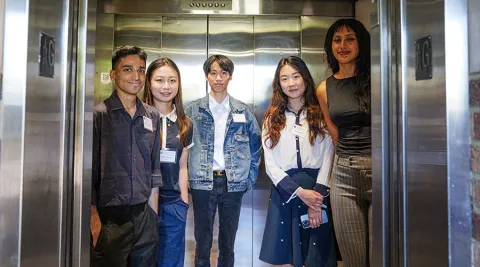
Elevating emerging engineers
The Industry Capstone Program partners UW Engineering students with sponsor organizations to devise innovative solutions to real-world problems.
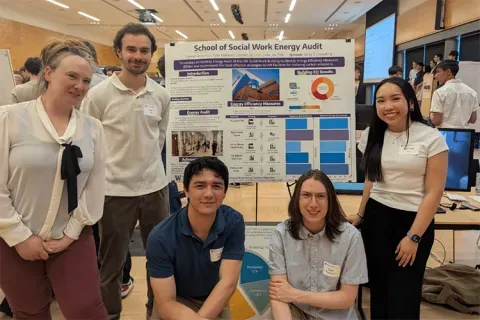
Capstone collaboration leads to award
An ME capstone team received first place for its energy audit of the UW School of Social Work building.
Capstone creations
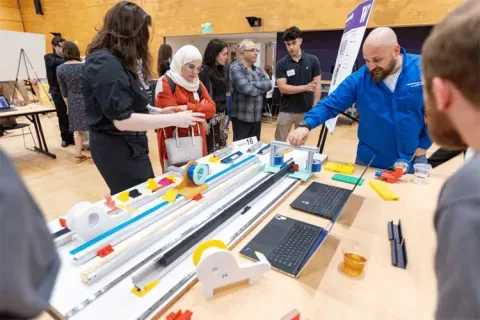
Students displayed innovative capstone design projects at the 2025 expo.