
Industry-Sponsored Student Capstone Projects
2025/2026
In the 2025/26 academic year the industry capstone program was supported by 83 sponsors, more than half of which were returning, and 116 real-world projects. Six hundred students from across the College of Engineering participated. Scroll down to learn more about each project.
Sony
Creating an Immersive Sports Watching Experience
Sony sought new ways to make watching sports at home more immersive and build on its existing role in home entertainment and sports partnerships. This project explored how emerging technologies could be integrated with Sony’s product portfolio, including televisions, personal audio, home audio, and connected devices, to create a more engaging fan experience. It produced a concept for an enhanced at-home sports viewing experience that considered how multiple entertainment products could work together to deepen immersion and better connect fans to live events. The results provided Sony with a fresh perspective on next-generation sports viewing, supported by research, a prototype, and a video demonstrating the concept.

Sound Transit
Reimagining Sound Transit's Digital Navigation
Sound Transit asked HCDE students to recommend an improved website architecture and navigation for soundtransit.org to meet the broad needs of the agency's target audiences and the ways they engage with the website. The project developed an evidence-informed set of recommendations based on discovery of current content production practices, a structured audit of the existing site architecture, and UX research and analysis, such as content audits, card sorting, usability testing, stakeholder interviews, peer agency research, persona analysis, and a review of analytics. The resulting recommendations and proposed changes were illustrated through design prototypes that responded to the objectives of the agency's audiences and allowed for consistent and accessible navigation across soundtransit.org, as well as design updates intended to elevate key information in the Sound Transit passenger journey.

Starbucks Coffee Company
Material Flow and Partner Efficiency
Starbucks sought a more tailored way to set up inventory materials at the coffeehouse level, since standard guidance does not reflect differences in individual business patterns and could lead to excess waste or insufficient stock. This project focused on developing a data-driven model to track and quantify inventory materials across coffeehouses by analyzing material flow patterns, historical sales data, coffeehouse-level ingredient usage reports, and observations collected in the Starbucks TRYER Innovation Center. The resulting capability was intended to identify key factors that influenced effective coffeehouse setup and highlight opportunities to improve production throughout the business day. By turning store-level data into actionable inventory insights, the project aimed to support more efficient operations, reduce waste, and improve cost management while maintaining Starbucks’ customer experience standards.

Sugino Corporation
Sugino Cavitation Abrasive Surface Finishing AM Effectiveness and Optimization
Laser Powder Bed Fusion (LPBF) has made it possible to produce metal parts with complex internal channels, hollow features, and other geometries that were difficult or impossible to create with conventional machining, but these parts often have internal contamination and rough surfaces that limit their usefulness. This project explored Sugino’s Cavitation Abrasive Surface Finishing (CASF) as a way to improve those rough surfaces in LPBF titanium parts and to better define where the process is most effective. The effort focused on building comparative data for multiple alloys, including titanium, Inconel, stainless steel, and aluminum, and on identifying treatment conditions that improved surface finish without reaching saturation or overtreatment. The student team also examined whether combining CASF with a workplace-safe, non-toxic chemical fluid could further remove additive manufacturing debris and smooth internal surface texture, and included initial scoping of how the process might treat blind internal passageways and cavities where abrasive flow was constrained. Together, the project aimed to establish a clearer testing and optimization basis for finishing complex additively manufactured metal features that had previously been difficult to access and improve.

T-Mobile
Drone AI: Real-Time 5G Video Analysis and Agentic LLM
This project, sponsored by T-Mobile, developed a 5G-based real-time drone video analysis system integrated with agentic LLMs. Drone video and telemetry data are transmitted via 5G to an edge node, where YOLOv12 performs object detection and Gemma3-4B generates captions. GPT-based models handle higher-level summarization and reasoning. Results, including detections and key flight/network KPIs, are stored in a database and visualized through an operator dashboard. The system supports natural language queries via an agent orchestrator and features an end-to-end, real-time, asynchronous processing pipeline.
Tacoma Power
Dynamic Line Rating Deployment Feasibility Study
Modern power grids face increasing load demands, forcing utilities to improve efficiency instead of pursuing costly infrastructure upgrades. This team was tasked with evaluating Dynamic Line Ratings (DLRs) as a feasible alternative. This evaluation was done by developing a tool that calculated theoretical DLR ratings through an analysis of historic weather data. These ratings were then compared to Tacoma’s existing methodology. The team also identified transmission routes that would benefit most from DLR implementation. The project found that DLR technology would increase line ratings by a meaningful margin, thereby allowing Tacoma to safely meet load demands without requiring expensive upgrades.

TE Connectivity
Monocular Cable Layer Segmentation and Dimension Measurement
This project presented a cross-platform mobile application for industrial cable dimension measurement. The system integrated AI segmentation (trained on a synthetic dataset) and advanced depth sensing, utilizing a multi-sensor fusion pipeline to support both LiDAR and non-LiDAR devices. To further enhance robustness, the team developed an independent calculation framework, effectively mitigating errors from imperfect AI masks. This approach eliminated single-point failures, delivering stable results for professional quality control.

Tesla
Integrated Heating and Emissions Abatement System for Industrial Ovens
Automotive paint, e-coat, and powder coat ovens typically rely on standalone Regenerative Thermal Oxidizers to abate Volatile Organic Compounds (VOC) emissions, adding significant capital cost and factory space requirements. This project developed a conceptual integrated Regenerative Thermal Oxidizer (RTO) approach within oven heater boxes to reduce system complexity, cost, and footprint while supporting applicable NFPA, air district, and building code requirements. The concept used regenerative thermal oxidation as the basis of design, with targets for VOC destruction, thermal efficiency, cold-start readiness, and modular airflow capacity across different oven applications. The work defined the proposed system through engineering calculations, computational fluid dynamics (CFD) analysis, conceptual layouts, P&IDs, functional diagrams, a parametric 3D design, and a cost comparison against a traditional standalone abatement system.

UW Applied Physics Laboratory (APL)
An Underwater Robot for Attaching Recovery Lines
Retrieving objects from the seafloor is typically done by human divers or remotely operated vehicles, which makes the process costly, time consuming, and dependent on specialized operators. This project aimed to develop a prototype “smart hook,” an ROV-inspired module mounted at the end of a winch line that could help automate attachment to subsea objects before they were lifted to the surface. The concept focused on cooperative objects designed for retrieval by the system, with the hook lowered near an approximate known location and then using limited horizontal motion and visual homing to search for, approach, and attach to the target. The prototype was intended to include core autonomy and control functions, along with manual control modes for testing, using a reconfigured BlueROV platform and a hardwired tether rather than wireless communication. The system was intended to support faster testing and recovery of subsea scientific instruments, with future versions potentially extending to less structured objects such as subsea debris.
UW Applied Physics Laboratory (APL)
Autonomous Algorithm Development for Exploring Deep-Sea Hydrothermal Plumes
The Autonomous Vent Finder project utilizes Gaussian regression, machine learning, and computer vision to locate deep-sea hydrothermal vents using an autonomous underwater vehicle. These vents discharge plumes that spread thousands of kilometers. They sustain distinctive deep-sea ecosystems and have large impacts on global ocean biogeochemistry. As the AUV traverses the plume, it collects plume-related data using onboard sensors and estimates the vent location. By training the algorithm to adapt to the changing conditions of the plume, the AUV can re-align itself to locate the vent more efficiently than traditional methods, which rely on pre-programmed paths and post-dive data analysis.
UW Applied Physics Laboratory (APL)
Enabling a Novel Low-Cost Salinity Sensor through Machine Learning
This team developed a robust machine-learning framework that corrects long-term drift in low-cost salinity sensors. Salinity data is vital for monitoring ocean health, tracking climate change, and managing sustainable aquaculture, yet high-quality equipment is often very expensive. While these low-cost sensors offer a scalable alternative compared to more expensive conductivity-temperature-depth instruments, they suffer from physical degradation like membrane hydration and ionophore leaching. By analyzing time-series data, which includes features such as voltage, impedance, and temperature, this model automatically separates true environmental variations from apparent changes caused by sensor drift.
UW Applied Physics Laboratory (APL)
Profiling the Ocean for Health
Expendable conductivity-temperature-depth profilers (XCTDs) record salinity and temperature profiles across depths to assess ocean conditions. These single-use devices often cost thousands of dollars per unit, creating an economic barrier for oceanographic research. This team developed Ion-XCTD: a lower-cost platform that preserves core XCTD functionality, integrating UW-APL’s recently developed ion-potential-based salinity sensor, a depth sensor, and a temperature probe. Ion-XCTD houses its embedded system in a waterproof enclosure and collects data as it descends via a spooled tether. The collected data is sent up the tether to a floating buoy where, it is wirelessly relayed to a remote receiver.

UW Department of Civil and Environmental Engineering
Prototyping a Self-Sufficient Harvester of Electricity-Water (SHEW) for Tall Buildings
The SHEW project seeks to develop a prototype system for harvesting electrical power by utilizing the collection of rainwater in conjunction with a hydro-turbine. With the help of UW CEE, among others, this project aims to design and test the feasibility of a compact hydroelectric system. The prototype consists of a rainwater collection tube and several systems that automate the release of water to drive a turbine. With the capability of producing energy for small and large-scale urban buildings, the system will store power for future use by smaller devices. The power produced can be used to support critical systems such as data centers and communication networks during power outages.

UW Materials Science & Engineering Department
H2 Production System for Submarine Propulsion, Phase 2
In this project hydrogen generation through an aluminum-water splitting process was pursued as a clean energy option for transportation applications such as watercraft and submersibles, with a need to improve reaction control, propulsion integration, and economic viability beyond an earlier prototype. The student team worked to develop a mini-submersible or watercraft platform that uses hydrogen produced onboard to power a throttleable propulsion system. The project focused on studying the factors that influenced hydrogen production rate, creating a reaction chamber for controlled experiments, and designing a propulsion approach with sound fluid dynamic and material considerations to manage both gas flow and excess heat from hydrogen generation. The team produced a prototype that could demonstrate adjustable hydrogen production and variable-speed propulsion, enabling evaluation of this energy approach for practical marine use, including potential operation in seawater and assessment of its commercial feasibility.

UW Medical Center
Miniaturization of UWMC Medical Equipment Asset Tracking Device
Every month, 10-15 pieces of medical equipment go missing at UW Medical Center because current tracking devices lose power and go silent, which costs the hospital $30 per replacement and hours of staff time. This team built a smarter, smaller asset tracker with a long-lasting battery, motion-based smart wakeup, and a live dashboard that sends maintenance alerts so staff always know where every device is. This team turned a chronic, expensive problem into a solution that hospitals can actually use to track these expensive tools.
Related News
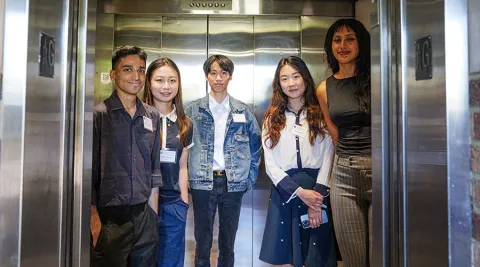
Elevating emerging engineers
The Industry Capstone Program partners UW Engineering students with sponsor organizations to devise innovation solutions to real-world problems.
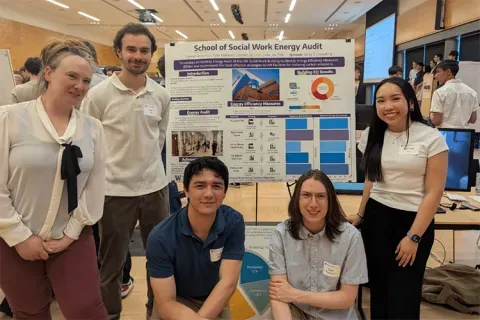
Capstone collaboration leads to award
An ME capstone team received first place for its energy audit of the UW School of Social Work building.
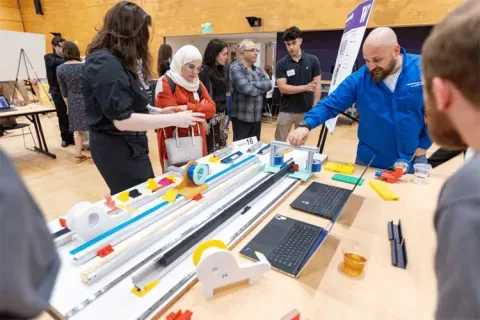
Capstone creations
Students displayed innovative capstone design projects at the 2025 expo.