
Industry-Sponsored Student Capstone Projects
2025/2026
In the 2025/26 academic year the industry capstone program was supported by 83 sponsors, more than half of which were returning, and 116 real-world projects. Six hundred students from across the College of Engineering participated. Scroll down to learn more about each project.
Adaptable House
Active Rest and Recovery: A Bed Mobility System
An athlete living with MS needed safer, more supportive ways to move, stretch, and exercise in and around a bed during periods of limited mobility, when getting in and out of bed and spending extended time in bed became especially challenging. The project explored a bed-adjacent mobility system intended to help a partially impaired user engage muscles and stretching while accommodating changing day-to-day needs, improving ease and security during bed transfers, and providing an aesthetic that felt calming and motivating. The work was aimed at producing a first-run prototype design and engineering concept suitable for future refinement toward a market-ready system.
Adaptable House
Ease of Use, Rest and Recovery: A Kitchen Mobility System
Because Multiple Sclerosis can cause day-to-day changes in physical capability, the sponsor needed a kitchen support system that could better accommodate mobility, stretching, and rest during routine meal preparation. The project developed a design concept for integrated kitchen assistance features intended to support activities such as accessing storage and refrigeration, washing and food preparation, cooking, cleaning, and waste disposal, while also providing immediate opportunities for resting and stretching. The concept considered overhead, wall-, counter-, and floor-supported elements, including fixed, pivoting, and movable configurations, to improve support and ease of use across a range of kitchen tasks. This work established an engineered foundation for future first-run prototyping of a more accessible kitchen environment.
Adaptable House
In-Home Overhead Mobility System for Adaptable House/Hanging Chair
Adaptable House Project needed a seating element that supported its integrated mobility system while remaining easy to use, compact when not in use, and visually appropriate for the home environment. This work focused on the design, build, and testing of a stowable "hanging chair" intended to provide a comfortable, playful, and aesthetically pleasing seating option that enabled the project’s full-support use mode. The effort produced design and engineering information to support creation of a full-scale working prototype, advancing a seating capability that could combine mobility support with simple operation and space-efficient storage.
Adaptable House
In-Home Overhead Mobility: Winch Design and 3D Demo
Adaptable House Project needed a cost-effective, reliable winching capability for an overhead mobility system intended to support people with changing mobility needs while encouraging physical movement and independence. To address this need, the project focused on the design of a scaled prototype winching system that could attach to an existing tabletop XY gantry and demonstrate key operating concepts for a future full-scale system. The resulting prototype was intended to show how a winch-based approach could support multiple modes of operation within the overhead mobility platform, and included controls developed to demonstrate basic system behavior.

Advanced Navigation and Position Corporation (ANPC)
GPS-Denied Drone Navigation
GPS signals are vulnerable to jamming, spoofing, and terrain obstruction, threatening autonomous vehicle operations. ANPC's Transponder Landing System (TLS) offers a GPS-independent positioning solution, currently used for manned military and research aircraft in complex terrain. This project demonstrated TLS as a viable drone navigation system by developing a GPS-TLS toggle algorithm capable of autonomously controlling a drone in GPS-denied environments. The system can maintain a maximum 10 ft deviation from a prescribed flight path at 100–400 ft AGL, reducing dependence on on-site pilots and enabling mission continuity where traditional navigation fails.

Affiliated Engineers, Inc.
Preliminary Design for UW’s Steam System Isolation
As part of the University of Washington’s broader campus decarbonization effort, this project addressed a previously identified need in the Energy Renewal Plan to separate process steam loads from the central campus steam distribution system. The project focused on assessing steam process demand and site conditions for a specific group of buildings, with particular attention to MHSC, and developing a preliminary recommendation for how those loads could be served independently. The proposed approach considered the sizing of supplemental steam heating systems in relation to available space and electrical capacity, along with project cost estimates. It also evaluated emerging options for full or partial electrification of steam demand, including resistive heat, air-source heat pumps, and thermal energy storage, to identify a practical pathway for reducing reliance on the existing steam network and supporting future energy system decarbonization.
AIWaysion
AI Video Analytics for Multimodal Traffic Safety and Design Countermeasures at Burke-Gilman Trail Crossings
This project develops an AI video analytics pipeline to quantify safety risks at the NW 43rd St and 8th Ave NW intersection in Seattle's Ballard neighborhood, where the Burke Gilman Trail crosses local streets. Sponsored by AIWaysion, the system integrates YOLO26 detection, BoT SORT tracking, CVAT based labeling, homography calibration, and short horizon trajectory prediction to compute time to collision and post encroachment time metrics. Outputs include conflict heatmaps and evidence based countermeasure recommendations for City of Seattle stakeholders to support data driven roadway safety decisions.

Akkadian
Guiding Instructors Through Syllabus Creation: A Human-Centered Approach to Reduce Cognitive Load
This project addressed the challenge instructors face when creating accessible, evidence-based syllabi without extensive course design training or time. A mid-fidelity prototype was developed for a web-based syllabus builder that would guide instructors through a structured, step-by-step workflow based on backward design, moving from course basics to learning objectives, assignments, and course materials. The design incorporated clear guidance, interactive features, and AI-supported recommendations tailored to institutional, disciplinary, and pedagogical preferences, with the goal of reducing cognitive load and supporting more consistent syllabus development. The prototype and accompanying design rationale documented user research insights and design decisions so the concept could inform future software development and continued refinement.

Amazon
Advancing Traffic Accident Data Analysis with LLMs
This project explored using large language models to turn traffic crash information from unstructured sources like police reports and narrative records into more organized data that was easier to analyze. The work aimed to assess whether these AI-generated outputs could be comparable to established structured databases while enabling analysis across diverse, underused data sources, and to clarify how AI could support transportation safety research through better data preparation and new perspectives on crash trends.
Amazon
Optimization of Image Generation Models for Edge
EdgeDiffuse explores the deployment of Stable Diffusion–based image generation models on resource-constrained edge devices. As generative AI models grow increasingly powerful, their computational demands limit accessibility beyond cloud infrastructure. This project addressed that gap by applying mixed-precision quantization, structured pruning, and knowledge distillation to compress Stable Diffusion for deployment on ARM-based hardware (Orange Pi RK3588), with and without NPU acceleration. The goal was to achieve at least 20–25% model size reduction while maintaining acceptable image quality, enabling real-time, on-device generative AI without cloud dependency.
Amazon (Global Engineering, Maintenance & Sustainability)
Agentic AI for BMS Trend Fault Detection & Insight Summaries in Building Operations
Facility operators often have limited time and tooling to interpret large volumes of building management system time‑series data and translate it into clear, actionable insights. This project developed an agentic AI prototype that ingested synthetic or anonymized HVAC and energy signals (such as zone temperature, discharge air temperature, setpoints, and compressor behavior) to detect trends and anomalies and produce plain‑English explanations and visuals. The system coordinated a repeatable loop of data retrieval, time‑series analysis (including trend decomposition, forecasting, change‑point detection, and comparisons of key parameters versus outside air temperature with basic weather/occupancy normalization), and an LLM-based narrative layer that generated “explain‑the‑why” summaries with guardrails and redaction. The prototype generates a weekly trend report with dashboard tiles from the synthetic dataset, supported by documentation such as model cards, a data dictionary, tests, and an evaluation summary describing errors, limitations, and next steps, while avoiding any PII or customer/site identifiers.
Amazon (Global Engineering, Maintenance & Sustainability)
Energy, Water, and Carbon Scorecard Analysis
Amazon’s Global Energy Automation and Sustainability organization needed better analytics to identify and prioritize opportunities to reduce operational emissions, water use, and embodied carbon across its global network. This project supported the development of a scorecard and related analytics capabilities intended to combine data pipelines, visualizations, forecasting, and insight generation for varying levels of water and energy consumption of new construction. At a high level, the system was designed to help surface actionable opportunities for control system optimization, operational and behavioral changes, retrofit initiatives, and lower‑carbon building decisions. The student team worked to provide a more consistent, data‑driven foundation for decarbonization and water efficiency programs in support of Amazon’s Climate Pledge commitments.
Amazon (Global Engineering, Maintenance & Sustainability)
IoT Vibration & Temperature Sensor Prototype for Predictive HVAC Motor Maintenance
This system delivered predictive maintenance for HVAC equipment through an IoT pipeline. Using Advantech WISE-2410 vibration/temperature/humidity sensors and Milesight CT305 current transformers, data was transmitted through LoRaWAN US915 to a Milesight UG65 gateway. A lightweight control layer is attached to MQTT topics (http for testing) and evaluates signals against ISO-10816 vibration thresholds and motor current baselines, and classifies emerging faults before failure happens. Detected anomalies generate maintenance tickets surfaced through a web dashboard and a fault ticket tracker. The system is also capable of being extended into existing building management systems.
Amazon (Global Engineering, Maintenance & Sustainability)
Occupancy-Based Control (OBC) Prototype for HVAC Systems Using IoT Sensors
This student team designed and prototyped an Occupancy-Based Control (OBC) strategy for commercial building HVAC systems, addressing the limitation of fixed airflow and CO₂-based demand-controlled ventilation approaches that may not reflect true real-time occupancy. The design integrated commercial IoT presence and occupant-counting sensors with a mock building management system (BMS) to dynamically reset zone-level ventilation setpoints for spaces such as offices and break rooms served by HVAC configurations such as single-zone rooftop units or variable air volume systems. The prototype included a control concept, system architecture, simulated performance analysis, and a dashboard for viewing occupancy signals and ventilation setpoints. Lab and testbed evaluation focused on estimating potential energy savings, assessing indoor air quality performance against ASHRAE 62.1 ventilation requirements, and outlining how the approach could scale to commercial building applications without field deployment or custom sensor development.
Amerability
NFL Blind Flag Football
Approximately 1 million people in the United States experience blindness or low-vision conditions. Despite football being the most popular American sport, accessibility in football is an underexplored field. This team developed the first rechargeable football with variable haptic and auditory feedback. Changing haptic patterns indicate proximity to the endzone, while pulse and continuous modes of auditory feedback relay whether the ball is airborne or carried. This technology enables people with varying levels of blindness to play an adapted version of flag football by signaling the location and state of the ball.
Related News
Elevating emerging engineers
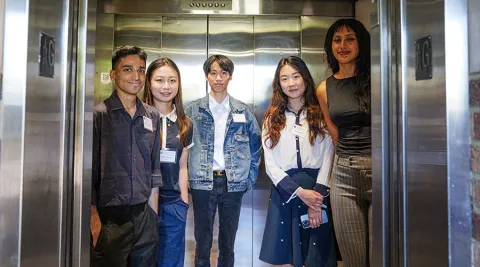
The Industry Capstone Program partners UW Engineering students with sponsor organizations to devise innovative solutions to real-world problems.
Capstone collaboration leads to award
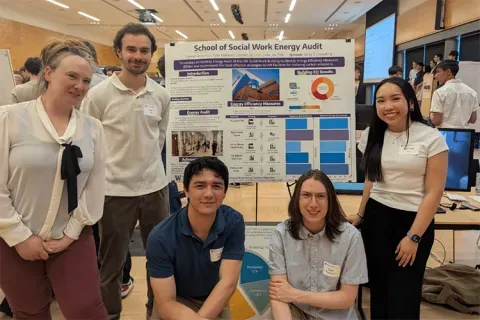
An ME capstone team received first place for its energy audit of the UW School of Social Work building.
Capstone creations
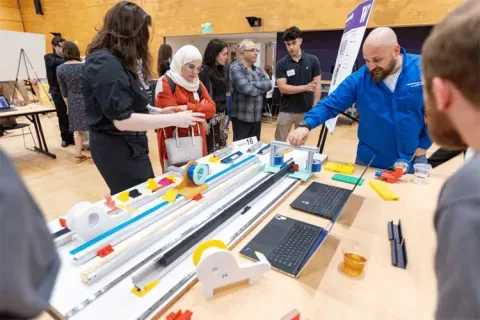
Students displayed innovative capstone design projects at the 2025 expo.