
Industry-Sponsored Student Capstone Projects
2025/2026
In the 2025/26 academic year the industry capstone program was supported by 83 sponsors, more than half of which were returning, and 116 real-world projects. Six hundred students from across the College of Engineering participated. Scroll down to learn more about each project.
Bremerton FoodLine
Warehouse Optimization
The goal of this project was to find a better way to manage client traffic through Bremerton Foodline's market-style food bank and improve the use of warehouse space that supports food distribution, clothing, senior food packs, pet food, and regional redistribution services. The student team developed an operations improvement plan focused on reducing client wait times, particularly at checkout, while supporting safe, dignified service. The team also addressed warehouse layout and workflow across restocking, repacking, sorting, and storage activities tied to Bremerton Foodline’s role in receiving large shipments, handling inventory, and supplying 17 partner organizations in Kitsap and North Mason counties. The design enables more efficient movement of people and products through the facility and supports higher-volume operations within the organization’s existing space.

Cascade Bicycle Club
Modular Bike Storage and Logistical Solution
Cascade Bicycle Club wanted to develop a safer, more efficient way to transport fully assembled bicycles in bulk from its South Seattle warehouse to schools across Washington. The existing approach relied on storing bikes and loading them one at a time into a 16-foot box truck, which limited capacity and added handling time. The project focused on developing a modular storage and loading system that would allow assembled bikes to be placed onto a rolling chassis in the warehouse, moved directly into the truck, and secured within the cargo bay for transport. The intent: to be operable by one or two people, support easy bike loading and unloading, and be durable, repairable, and replicable if unfinished. This capability aimed to combine storage and loading into a single process and reduce the labor and safety challenges of the club’s current shipping method.

CoMotion
Patent TTO Game
CoMotion aims to develop a more polished and accessible version of Patent Quest, an educational fantasy role-playing game used to teach intellectual property and patent prosecution concepts. This project focused on refining the game’s rules, mechanics, scenarios, and visual design so it could better support inventors, law students, and technology transfer professionals. Patent Quest uses narrative-driven challenges and dice-based play to model key steps and obstacles in patent filing, prosecution, and issuance, while maintaining an easy-to-learn fantasy theme suited for repeated play. The board game and/or digital app prototypes developed were intended to support training, outreach, and professional development by making patent concepts more engaging, understandable, and interactive.

Crane Aerospace & Electronics
Vapor Degreaser Solvent Replacement
Crane Aerospace & Electronics needed a long-term replacement for Vertrel SFR after Chemours announced the solvent’s discontinuation. The project evaluated alternative cleaning solvents for vapor degreasing applications, with attention to compatibility with existing CAE equipment, electronic materials, and inspection requirements including IPC and MIL-STD criteria. Candidate solvents were reviewed and down-selected based on their ability to remove contaminants such as fluxes, solder pastes, oils, and greases without degrading materials already present in devices, including silicones, epoxies, and component coatings. The work produced a testing approach, material compatibility and cleanliness data, and a recommended replacement solvent path for further CAE validation.

Cyberworks Robotics
AI Vision Autonomous Navigation in Dense Crowds
Autonomous navigation needs to consider various factors. This project develops an AI-driven navigation system for autonomous wheelchairs operating in heavily crowded environments. Using a machine learning pipeline, the system detects nearby pedestrians and classifies situations as “avoid” or “don’t avoid” based on crowd density. A Gazebo simulation with configurable crowds is used for development and testing. The classifier is integrated into the motion planner to enable real-time decisions such as yielding, stopping, or rerouting. The system is validated through simulation and targeted for real-world deployment in environments like hospitals and airports to improve mobility and safety.
Cyberworks Robotics
Deep Reinforcement Learning Path Planner for Self-Driving
Autonomous Self-Driving wheelchairs increase freedom and ease of mobility for the most vulnerable people in society. Cyberworks Robotics is the global leader in the design of such technology. Students worked on developing and optimizing cutting edge Machine Learning, Computer Vision and other technologies that push the envelope in the capabilities of such self-driving wheelchairs so that they can operate in ever-more complex environments. This project reimplements and evaluates deep reinforcement learning-based local planners (SACPlanner and a hybrid classical/RL planner) against a classical TEB baseline for autonomous wheelchair navigation. The system is integrated into the ROS1 Noetic navigation stack and validated in both Gazebo simulation and real-world wheelchair experiments. Evaluation scenarios include narrow corridors, dynamic obstacles, and localization challenges. Performance is measured using success rate, collision rate, trajectory deviation, and planning latency to assess robustness and sim-to-real feasibility, leading to a deployment recommendation for assistive wheelchair navigation.

Daher
Impact of Thermal Consolidation on Thermoplastic Material
The project addressed a need to understand how thermal cycling during manufacturing affected the health and performance of a thermoplastic composite structure. Panels were produced by press consolidation under defined conditions, then subjected to additional thermal exposures to represent repeated manufacturing heat cycles. After each exposure, the material was evaluated using visual and ultrasonic non-destructive inspection, along with dynamic mechanical analysis and differential scanning calorimetry to assess thermal transition behavior and degree of crystallinity. Flexural specimens were also taken from the panels for property testing, with care taken to avoid extraction damage, and additional furnace exposure at about 250°C could be used if needed. The work was intended to provide a report linking thermal cycling to crystallization, material condition, and resulting material properties.

Department of Electrical and Computer Engineering
Computer Vision Pipeline to Detect, Track, and Quantify Feeding Habits of Katmai NPP Alaskan Brown Bears
This team built an open-source computer vision pipeline that automatically identifies, tracks, and counts Alaskan brown bears from live webcam footage from Katmai National Park, achieving 91% recall using fine-tuned YOLOv8 and ByteTrack. The system also quantifies individual feeding behavior and integrates real-time environmental data to produce structured ecological research insights. Katmai is home to 2,200 bears that congregate annually at Brooks Falls to feed on spawning salmon. Monitoring one of the most concentrated wildlife spectacles on Earth, however, currently relies on error-prone manual observations. This project addressed this problem and improved ecologic measurements through continuous computer vision data analysis.
EdgePerma: Pragtree Farm
Mobile Regenerative Agriculture Networked Chicken Coop
This project addressed a need for pasture-based poultry infrastructure that was easier to move, better suited to smaller farms, and compatible with diversified agricultural systems. Traditional mobile coops are often large, cumbersome, and dependent on tractors, which limits accessibility and increases labor, fuel use, and maintenance. The work focused on designing and prototyping a lightweight, mobile, predator-resistant chicken coop for use in pasture and silvopasture settings. The concept was intended to withstand environmental stresses, exclude common predators such as coyotes and raccoons, and support ergonomic use with cost-conscious, scalable construction for small- to mid-sized farms. A key aspect of the design was aligning the coop’s size and mobility with crop row spacing in orchard and agroforestry systems such as blueberries, apples, and hazelnuts. This approach was intended to let poultry move more seamlessly through working agricultural landscapes while supporting broader regenerative farming goals, including reduced fossil fuel dependence and improved integration of animal, crop, and ecological functions.

FEI Company (a part of Thermo Fisher Scientific)
AI Integrated SEM Imaging Analysis Workflow Development for Battery Manufacturing
This project addressed battery manufacturing characterization challenges by evaluating scanning electron microscope imaging and associated software features for automated SEM data collection and image analysis. The work focused on battery-relevant samples such as current collectors, cathodes, and anodes, with attention to imaging parameters including accelerating voltage, beam current, and field of view, as well as automation capabilities such as stage navigation, multiple regions of interest, and automatic acquisition. The evaluation aimed to provide validation and feedback on SEM workflows and AI-enabled tools, including Autoscript and ChemiSEM, for use cases related to throughput, defect detection, and microstructure analysis in smart battery manufacturing.

GA8ED
Modular Open-Source PTZ AI Camera Platform for Smart Neighborhood Applications
This project built a prototype modular PTZ camera system with on-device AI detection and tracking. The goal was to create an open system that is easy to modify and extend. Currently available similar systems are typically proprietary and thus are difficult to extend or customize based on the use case. This system supported different power, network, and hardware modules so that each potential user can tailor the device to their specific needs. The compute platform ran AI directly on the device to reduce delay and improve reliability, and the device was powered via either PoE (power over ethernet) or USB-C with battery and solar support to increase reliability.

GE Vernova
Modeling UW Campus and Battery Design as Flexible Load
In partnership with GE Vernova, this project aimed to improve energy efficiency, flexibility, and cost performance on the University of Washington Seattle campus through electrical system modeling and battery storage design. An OpenDSS model of the campus distribution system, including feeders, transformers, and building loads, was developed. With this model, steady-state and time-series power flow studies were conducted to identify congestion and peak demand periods. Based on these results, HOMER Grid software was used to design battery energy storage systems for peak shaving and load shifting, supporting cost savings, long-term grid flexibility, and future campus energy planning.

General Dynamics
Flight Vehicle Visualization
This project developed a tool to visualize drone flight using both simulated and real telemetry data. The system creates a complete pipeline that takes raw flight data, converts it into a standardized format, and generates a realistic 3D animation of the drone’s motion. The key components included a 6DOF physics-based simulation, telemetry data processing, and an interactive user interface that was built in MATLAB/Simulink. This framework allows users to analyze drone behavior and compare simulated results with real-world data, supporting the development of promotional material to highlight product capabilities.
General Dynamics
Navigation Filter and Transfer Alignment Framework for a Drone Dropped Airframe
This project focused on the development of a navigation filter for an airframe deployed from a carrier drone, addressing the need for reliable autonomous operation after separation. The system was designed to estimate the airframe’s position, velocity, and orientation using onboard sensors such as magnetometers, gyroscopes, and accelerometers, with optional GPS input and the ability to continue operating when GPS measurements were unreliable or unavailable. The design also included transfer alignment from the drone’s navigation system so the airframe could receive initial state data before deployment. The student team used modeling, simulation, bench testing, and system-level testing to evaluate sensor fusion, filter stability, tunability, and performance under varying flight conditions, with supporting documentation and software intended to make the navigation capability usable and configurable.
Re-Imagining the User Flows of the Docs Site to Support the Changing Paradigms of Information Seeking in the AI Era
This project explored how to re-imagine the homepage experience for docs.cloud.google.com, as user behavior shifts in the era of AI-assisted information seeking. The project examined the needs of developers using or considering Google Cloud products and services, with a focus on helping users find information more effectively and complete product-related tasks. The project aimed to inform a new set of homepage and documentation discovery experiences that could support both traditional browsing and AI-assisted journeys, while identifying where AI features, classic website improvements, or broader experience changes could best address current user needs. Foundational research, design exploration, prototyping, evaluation, and potential A/B testing were considered as ways to guide future investment and measure impact.
Related News
Elevating emerging engineers
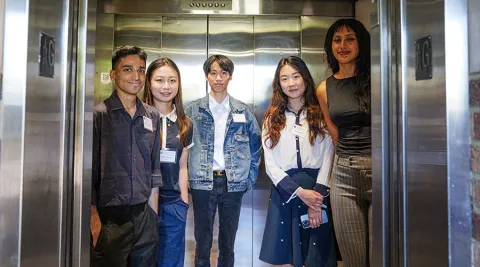
The Industry Capstone Program partners UW Engineering students with sponsor organizations to devise innovative solutions to real-world problems.
Capstone collaboration leads to award
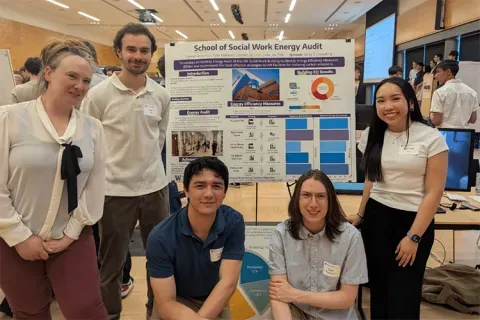
An ME capstone team received first place for its energy audit of the UW School of Social Work building.
Capstone creations
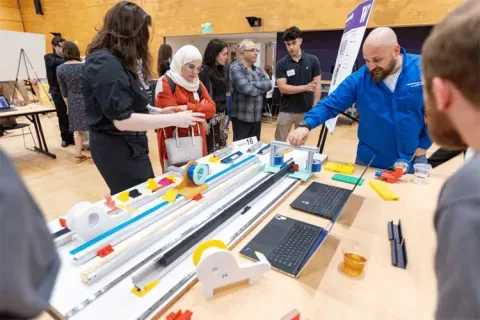
Students displayed innovative capstone design projects at the 2025 expo.