Industry-Sponsored Student Capstone Projects
2025/2026
In the 2025/26 academic year the industry capstone program was supported by 83 sponsors, more than half of which were returning, and 116 real-world projects. Six hundred students from across the College of Engineering participated. Scroll down to learn more about each project.
PACCAR
Battery Pack Mechanical Mounting & Thermal Interface
The E-Truck Challenge began in late 2023 through a partnership with PACCAR to retrofit a Class 7 Peterbilt truck into an all-electric vehicle over four years. The effort grew to include a broader UW student engagement through a Registered Student Organization (RSO) focused on giving participants hands-on experience with industry components, software, and engineering practices while advancing cleaner transportation. Within that larger vehicle conversion effort, this capstone project addressed a need to integrate CATL battery strings into the truck architecture with secure mounting and safe connections to the cooling and high-voltage electrical systems. The students worked to define battery, high-voltage junction box, and S-Box locations and develop a complete design for mounting and connecting the battery system within the vehicle.
PACCAR
Charging HW & SW
The E-Truck Challenge began in late 2023 through a partnership with PACCAR to retrofit a Class 7 Peterbilt truck into an all-electric vehicle over four years. The effort grew to include a broader UW student engagement through a Registered Student Organization (RSO) focused on giving participants hands-on experience with industry components, software, and engineering practices while advancing cleaner transportation. The charge control unit (CCU) of an electric vehicle is an integral component, as it regulates the current flow between the charging station (EVSE) and the vehicle’s battery. As the truck is converted from a diesel-based system to an all-electric vehicle, the CCU must process an increased number of signals from other components, such as the vehicle control unit (VCU). This project involved developing software for the handshake sequence required to initiate charging using CAN bus signal messaging, the Raptor system, and the charging inlet. The software was then tested on physical hardware using hardware-in-the-loop testing with CANalyzer.
PACCAR
High Strain Fatigue Properties of Metton
The focus of this project was to obtain better guidance on the high-strain fatigue limits of Metton to support more robust next-generation vocational hood designs. This project developed a strain-controlled flexural fatigue testing capability for Metton specimens cut from parts, including research into suitable bending fatigue methods and the development of a test fixture intended to apply high strain levels in a controlled way. The work aimed to use high-strain bending fatigue data to define Metton design guidelines for low-cycle fatigue conditions below 100,000 cycles to failure. This capability addressed a key limitation in evaluating material performance at elevated strain levels and provided a basis for establishing more reliable strain limits, while recognizing that test variability could be affected by method control and equipment calibration.
PACCAR
Positive / Negative Torque Control
The E-Truck Challenge began in late 2023 through a partnership with PACCAR to retrofit a Class 7 Peterbilt truck into an all-electric vehicle over four years. The effort grew to include a broader UW student engagement through a Registered Student Organization (RSO) focused on giving participants hands-on experience with industry components, software, and engineering practices while advancing cleaner transportation. This team contributed to the electrification of the donated truck chassis by developing torque logic using Simulink, CANalyzer, and Raptor, for deployment on the electronic control unit. Prioritizing safety and efficiency, the developed software ensures precise and reliable power delivery to the wheels all while using SAE J1939 standards for easy integration and seamless adaptation.
Pfizer
Membrane-Based WFI
Water for Injection (WFI) is critical in biotech for producing sterile, safe pharmaceutical products and medical devices by providing a highly purified, pyrogen-free solvent and diluent for injectable drugs, and for cleaning/rinsing production and packaging equipment. The North Creek site relies on a single distillation-based WFI generation system, meaning a catastrophic failure could disrupt manufacturing by removing a critical source of highly purified, pyrogen-free water used for injectable drug production and for cleaning and rinsing equipment. The project developed a business case for adding a second WFI generation system and compared newer membrane-based purification technology with traditional distillation. The assessment was intended to define the problem and opportunity, evaluate potential benefits, costs, risks, feasibility, and success criteria, and support justification of a redundant WFI capability. To inform that comparison, the work included a process flow diagram, mass and heat balance, capital cost estimate, and annual operating expense tabulation, providing a structured basis for evaluating alternatives and improving system redundancy for manufacturing operations.

PsiQuantum
Quantum Routines: Implementation, Verification, and Resource Estimation
As quantum computing advances towards fault tolerance at scale, the need for optimized quantum algorithms and algorithmic building blocks, such as arithmetic, state preparation, or block encoding, continues to grow. In this project, students learned to implement building blocks of quantum algorithms as code in a high-level quantum programming language, test their correctness, and analyze their performance.
Radian Aerospace
Radian One Sled / Vehicle Aerodynamic & Structural Loads Analysis and Design Improvement
The goal of this project involved figuring out a way to support the fully fueled 2.9 million pound Radian One vehicle during its ground sled run, when its wings carry very cold liquid oxygen and experience high rolling loads that could otherwise drive wing structural weight beyond mission limits. The project focused on a wing support system intended to reduce overall flight vehicle weight by carrying wing loads on the sled while still allowing enough airflow beneath the wings for normal takeoff. The concept evaluation considered alternative support approaches and their potential effect on dry weight, operability, wing aerodynamic performance, drag, and the risk of choked flow during separation conditions. A subscale model of the support system was built to enable wind tunnel testing and structural analysis.
Riverlane Ltd.
Quantum Error Correction Tools
The goal of this project was to create an open-source contribution to Deltakit, Riverlane’s quantum error correction library. This project focused on contributing a new feature to the public Deltakit repository, such as improvements to a stabilizer simulator, visualization tools for error-correcting codes, analysis tools for error budgeting, or integration of an open-source decoder. The design includes tests, documentation, and docstrings, with feature-specific attention to accuracy and runtime performance, helping strengthen Deltakit as a usable platform for quantum error correction development.
S2 Sustainable Solutions LLC
Micro/Nano-Bubble Delivery Mechanism of Ecologically Safe Agents for Burrowing Shrimp Control
Ghost shrimp burrowing in Willapa Bay and Grays Harbor damage oyster beds by causing oysters to sink and suffocate, and the pesticide control option, carbaryl, is now banned. In response to Washington state’s direction to research more sustainable pest management for shellfish growers, this project advanced a bubble-based delivery approach for shrimp control agents in saltwater environments. This work was conducted in collaboration with the University of Washington’s Pozzo Laboratory and Massa Products, a leader in ultrasound design and production. The system aimed to bind substances such as clove oil, PyGanic, or Chitosan to stable micro- and nanobubble emulsions that could move into shrimp burrows while oyster beds were submerged. Underwater ultrasound transducers were intended to collapse the carrier bubbles and release the agents directly into the shrimp habitat, enabling treatment at high water rather than only during rare low-tide conditions. The work focused on refining emulsion stability and reproducibility, preparing samples for ultrasonic bursting tests, and considering how the materials could be produced and supplied at a scale relevant to Washington’s oyster industry.

Scaniano
Scaniano2: AI Optical Character/Music Recognition to QR Code Generator
Scaniano is a platform that allows people of all ages to make music without prior experience. Users arrange labeled note cubes on a board, and a scanner is used to convert the blocks to music notes for playback, which can be encoded into QR codes and printed as labels for physical songbooks. Scaniano2 is a continuation of this project, which significantly improved the hardware and features of the prototype. Key upgrades include a custom touch-screen interface and optical music recognition, which allows users to scan both blocks and music sheets with a camera. By integrating the camera and printer interfaces, Scaniano2 provides a scalable, user-friendly workflow wrapped in an intuitive app.

Seattle City Light
Long-Term Cellular Signal Quality Logger
Seattle City Light is replacing manual distribution switches with remotely controllable units, with 77 installed since 2016 and several hundred potential locations identified. Deployment has been limited in part by reliance on fiber optic communications, prompting the need to evaluate alternative approaches (such as cellular) that could reduce cost and accelerate installation while maintaining comparable reliability. This project team's solution supports Seattle City Light's smart switch deployment via data-driven site qualification. Students built a battery-powered LTE signal quality logger measuring RSSI, RSRQ, RSRP and SINR over months optimized for ultra-low power on our custom PCB designed for outdoor deployment. Robust firmware pairs with a scalable website to visualize device health, GPS location, ping time and outage patterns in real time. This end-to-end pipeline reduces installation risk and enables informed deployment decisions for switch locations, accelerating Seattle's shift from legacy grid infrastructure to a connected smart electric grid.
Snohomish County
Snohomish County Evergreen State Fair
This project focused on the Evergreen State Fair's need for long-term planning insight to support a positive visitor experience for more than 300,000 annual fairgoers, while also making effective use of its year-round facilities. The project examined how guests moved through the fairgrounds, including circulation between exhibit areas, food courts, parking, traffic areas, and major venues such as event centers, arenas, and grandstands. Using existing data collected by the fair, the student team performed simulations of guest movement and identified opportunities for space layout and facility use that could help County Fair leadership plan future improvements.
Snohomish County PUD
Culmback Dam – Morning Glory Spillway Gate Raise
Spada Lake supplies raw water to much of Snohomish County and supports power generation at the Jackson Hydroelectric Project before discharging to the Sultan River and the City of Everett’s filtration system. As water demand increases and snowpack and precipitation become less predictable, interest has grown in storing more water in late spring for use during summer and fall. Because Spada Lake is formed by Culmback Dam and uses a morning-glory spillway, a seasonal spillway-raising gate was considered as a practical way to increase storage. The project aimed to develop an early-stage design concept for a system to raise and lower the spillway seasonally, and to examine the potential value and impacts of that added storage. This included reviewing cost-benefit tradeoffs at different storage heights, identifying needed structural analyses, assessing possible inundation effects around the lake, interpreting climate-related hydrology changes in the Sultan Basin, and summarizing operational considerations for making better use of increased summer water storage.
Snohomish County PUD
Darrington Community Microgrid
In partnership with Snohomish PUD, this team developed multiple microgrid designs that aim to reduce utility costs and provide outage support for the critical loads of the remote community of Darrington, WA. HOMER PRO and Helioscope were utilized to recommend optimized battery and solar array sizes. Additionally, design aspects were developed for a microcontroller that maintains system stability between changing operation modes and worst-case scenarios. While designs supporting existing load profiles were technically viable, their associated costs were exorbitant enough that the team also designed and recommended a full HVAC retrofit, enabling a significantly more cost-effective microgrid solution.
Snohomish County PUD
Demand Response Applications for Utilities
As utilities work to incorporate Distributed Energy Resources (DERs) into the distribution grid, new communications and control schemes will need to be developed to fully realize the benefits of distributed generation resources and flexible electrical loads. Communication between devices and utilities are becoming more standardized, but most utilities do not have a framework in place to send price or dispatch signals to non-utility owned devices. Snohomish PUD was looking for this student tam to explore the challenges and feasibility of developing the hardware and software systems needed for the utility to begin utilizing customer-owned DERs for utility benefit. This team developed a simulated client–server environment modeling utility-issued control events and device responses. The system includes device identification, event scheduling, polling-based communication, and status reporting. Results demonstrate the feasibility of standardized DER communication while highlighting challenges in certificate management and interoperability, informing scalable real-world deployment.
Related News
Elevating emerging engineers
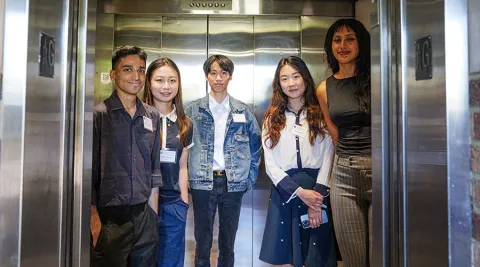
The Industry Capstone Program partners UW Engineering students with sponsor organizations to devise innovative solutions to real-world problems.
Capstone collaboration leads to award
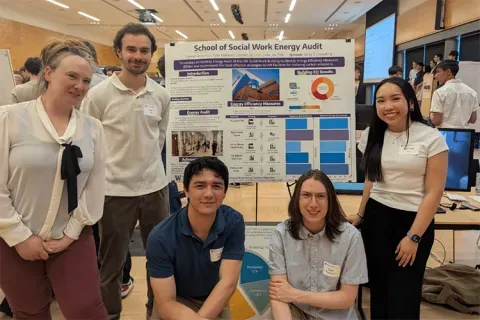
An ME capstone team received first place for its energy audit of the UW School of Social Work building.
Capstone creations
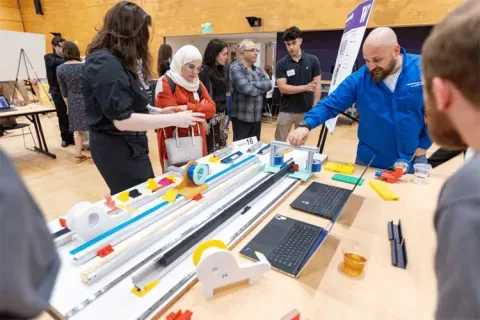
Students displayed innovative capstone design projects at the 2025 expo.