By Ed Kromer
The Industry Capstone Program partners UW Engineering students with sponsor organizations to devise innovative solutions to real-world problems.
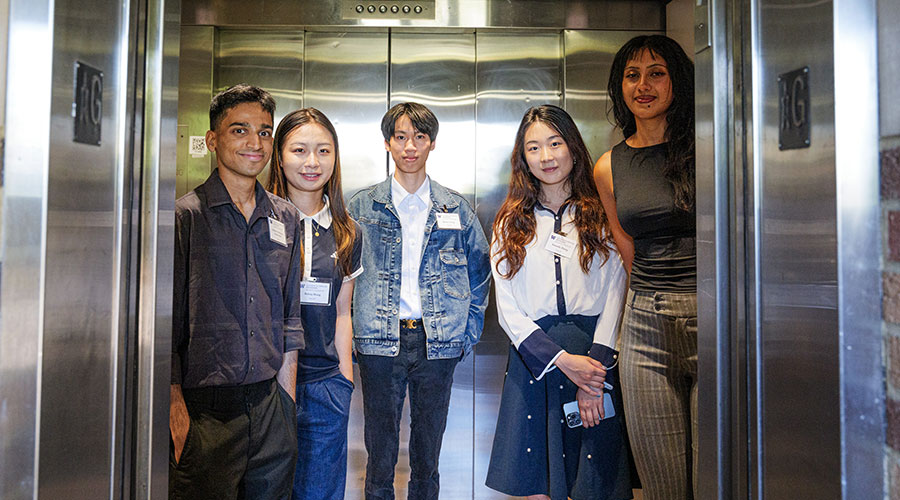
UW Engineering students (left to right) Aakash Namboodiri, Biliu Wang, Steven Gong, Amanda Zhang and Kuhu Nain tackled a technical challenge in partnership with the Otis Elevator Company through the Industry Capstone Program. Photo by Ryan Hoover
An elevator seems like a simple machine: Press a button, step inside. Press another, travel up or down. But behind the control panel of any given unit is a black box of distinct signals that can be difficult to interpret.
Decoding those signals in a systematic way became a most compelling preoccupation for a team of engineering students during their final two quarters at the UW.
They came to this project through the Industry Capstone Program, which challenges graduating seniors to solve real-world engineering challenges posed — and sponsored — by companies, nonprofits and government organizations.
For students, the program represents a comprehensive final exam, requiring them to apply their entire education. But it provides benefits on both sides of the equation.
“Capstone sponsors partner on exploratory or innovation-focused work while mentoring emerging engineering students,” says program director Jill Kaatz. “Many companies also use the program to tackle smaller-scale projects that benefit from fresh perspectives. And our students get an invaluable hands-on, practical experience to kickstart their careers.”
In this year’s Industry Capstone Program, 600 students from nine different engineering disciplines tackled 116 different projects created and sponsored by 79 partner organizations, including Amazon, Blue Origin, WSDOT, PACCAR, Boeing — and, for the first time, the Otis Elevator Company.
Out of comfort, in good company
The students working with Otis did not initially expect the inner workings of elevators to present such a fascinating challenge. They were tasked with developing an AI-powered framework to automate the software protocols in an elevator control system.
“Any student who starts this project is likely to think: it’s an elevator — how difficult could it be?” says the team’s faculty mentor Mahmood Hameed, an associate teaching professor in electrical and computer engineering (ECE). “But the students figured out very quickly that elevator controls are not at all simple. They operate in an enormous sea of signals. Navigating this required a steep learning curve for everyone.”
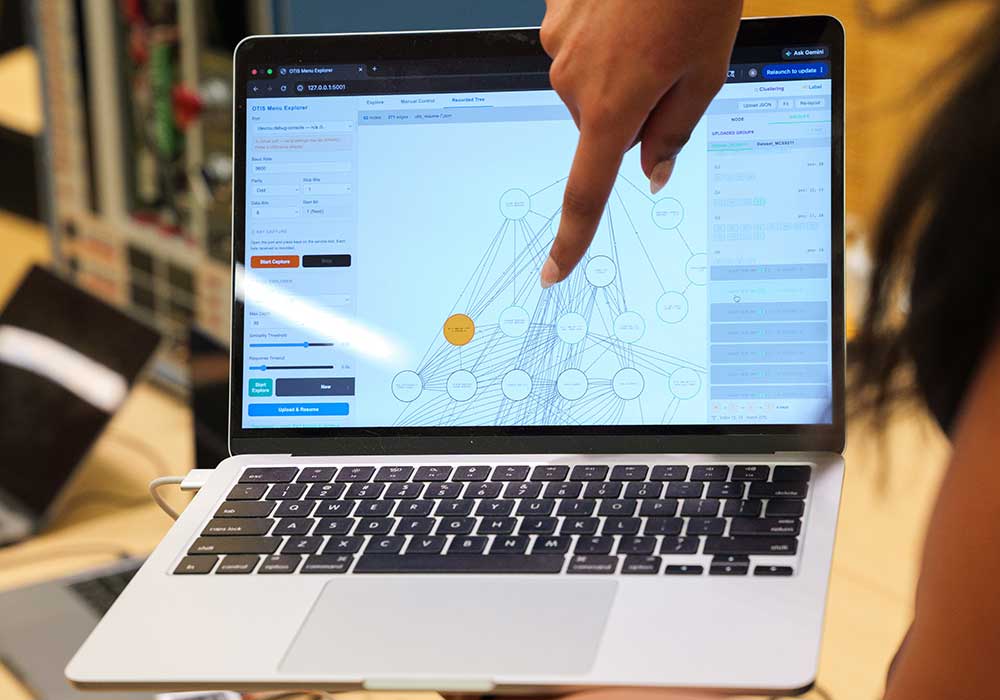
In collaboration with the sponsoring company, the team developed an AI framework to automate reverse engineering of the embedded elevator system’s service interface. Photo by Ryan Hoover
Especially since those signals often speak in different languages.
Beside Hameed and teaching assistant Zach Hao, the students received mentoring for this decoding project from a veteran team of Otis engineers. They also worked with a technician who helped them operate an elevator system simulator that Otis provided — a blue box, the size of a mini fridge, equipped with all the controls, sensors and actuators that drive the real thing.
“Getting to interact with people who are so knowledgeable and passionate about this project was incredibly helpful,” says Aakash Namboodiri, an ECE senior and team lead.
A journey as vital as its destination
The team, assembled by program administrators and faculty, had to quickly learn how to work together. “None of us knew each other before,” says ECE senior Kuhu Nain. “So open communication was most important.”
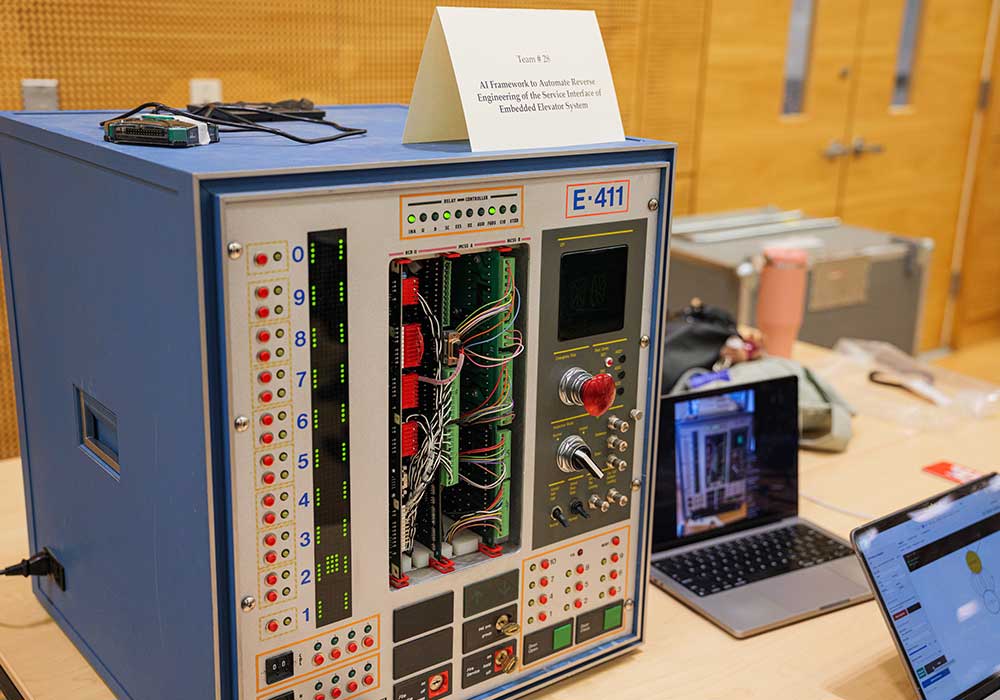
To facilitate the project, Otis provided the team an elevator control simulator used to train elevator technicians — as well as a team of expert mentors. Photo by Ryan Hoover
They practiced this constantly, through daily meetings and chats among the team and weekly check-ins with their Otis and UW mentors. Hameed encouraged them to ask questions, no matter how simple, and to take nothing for granted. “This is a learning experience,” he says, “not a time to be timid.”
That advice was especially relevant in the disorienting first weeks of the project. “I saw ‘AI framework’ and ‘reverse engineering’ in the project description and thought that sounded cool,” Nain says. “But once we actually got into it, it took us a month just to understand what we were actually doing.”
Once they did, the project took off. The team’s elegant AI solution impressed their sponsor and tied for first prize at ECE’s ENGINE capstone showcase.
What’s in it for Otis
The Industry Capstone Program offers participating organizations many benefits, from low-cost innovation to engagement with talented students to non-exclusive commercial licensing of any intellectual property developed.

Partnering with UW’s Industry Capstone Program allows us to engage directly with emerging engineering talent while advancing real-world challenges in our industry. It’s a true two-way exchange: Students gain hands-on experience in a critical industry, and we benefit from fresh thinking and new perspectives.”
Joseph Armas, ’98
President of Otis Americas
For Otis, perhaps the greatest value has come from observing the process the students took to solve an ambiguous and expensive problem.
“Reverse engineering an elevator manually is kind of a brute-force process,” says Sally Mahoney, a longtime Otis engineer who worked with the team. “So, we were excited to watch the process taken to crack the code by this team of young, smart engineers who have all the latest training and tools — but didn’t know anything about elevators. What they brought to this problem was what we wanted to see: fresh eyes.”
Related story
And curious minds.
That was the hope when Joseph Armas, ’98, president of Otis Americas, first proposed this project. “Partnering with UW’s Industry Capstone Program allows us to engage directly with emerging engineering talent while advancing real-world challenges in our industry,” says Armas, a UW graduate with a degree in aeronautics and astronautics. “It’s a true two-way exchange: Students gain hands-on experience in a critical industry, and we benefit from fresh thinking and new perspectives. Their first-place finish is a great example of what that collaboration can achieve.”
Going up
For students, the Industry Capstone Program is “the bridge between the classroom and the world they’re going into,” says Hameed. “Not only do they draw on things they’ve learned, but also on some things that they need to learn but haven’t yet, which is cool.”
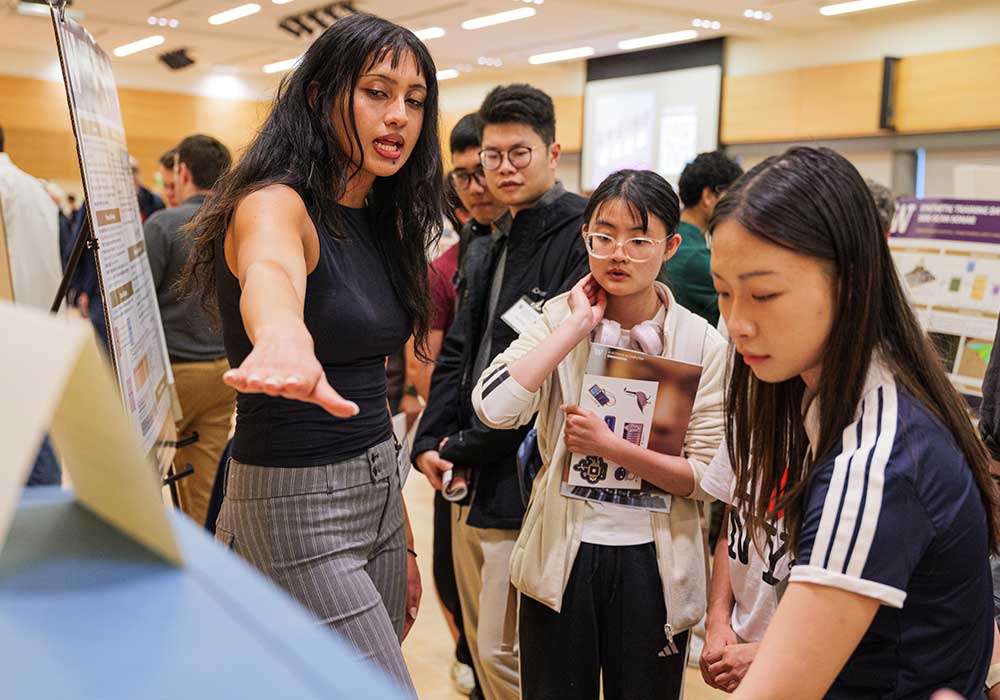
Kuhu Nain (left) explains the team’s solution, which tied for first prize at the annual ENGINE Showcase of capstone programs. Photo by Ryan Hoover
Cool, yes. But also calculated. The challenge presented to the Otis team could be seen as a microcosm of what lies ahead in their careers — a black box of signals that will need to be decoded.
“When students graduate and go into industry, they are often presented with work that someone else has done and left them to understand,” Hameed adds. “These capstone projects are exactly like that: reverse engineering legacy processes to understand how technologies could be improved.”
Through a wider lens, the experience delivers a message of empowerment to the next generation of engineers.
“We live in a time when things are constantly changing,” says Nain. “And if we have the skills and tools to affect change, why wouldn’t we?”
Keep exploring
Learn more about the Industry Capstone Program and how your organization can become a partner. Project proposals are due in mid-September.
Originally published July 6, 2026