
Industry-Sponsored Student Capstone Projects
2025/2026
In the 2025/26 academic year the industry capstone program was supported by 83 sponsors, more than half of which were returning, and 116 real-world projects. Six hundred students from across the College of Engineering participated. Scroll down to learn more about each project.
McKinstry
Waste Heat to Warm Cities: Using Micro-Data Centers to Decarbonize Seattle
This project focused on the need to assess whether small, distributed data centers could support lower-carbon heating in Seattle’s dense urban core, where district steam and natural gas systems contribute significantly to building emissions. The student team explored micro-data centers as part of a block-level eco-district strategy, using recovered computing heat as a potential neighborhood energy source while supporting growing data center demand. The project focused on a candidate downtown block or building and examined heating and cooling loads, electrical demand and service capacity, and available space to assess feasibility. The resulting concept includes a block load model, preliminary sizing for the data center and core energy infrastructure, a plan for connecting recovered heat to nearby buildings, and an evaluation of potential energy and carbon benefits, with a conceptual economic review where feasible.

Membrion
Calculation of Cu Concentration in Industrial Waste Streams
One of Membrion's target markets is semiconductor and electrodeposition wastewaters. In-line metal concentration measurements of these streams are not straightforward due to fluctuations in the quality of customer waters. Conductivity and refractive index can be relatively straightforward measurements to determine metal concentrations, but are convoluted by changes in pH and turbidity. To address this limitation, the project investigated representative wastewater compositions relevant to Membrion’s target market and developed an experimental matrix of mixed-metal solutions containing copper salts, additional metallic salts, and acids. The solutions were characterized using conductivity, pH, turbidity, and refractive index measurements, and the resulting data supported development of a predictive model to estimate copper concentration from these more easily measured parameters. This work aimed to provide a calculator or software tool that could infer copper concentrations in complex process streams where direct measurement was difficult.

Micron
Generative AI for Semiconductor Manufacturing
Micron sought to better understand how generative AI could accelerate analysis of complex semiconductor manufacturing data and help reveal patterns tied to key fab performance metrics. This project investigated the use of generative AI to explore a large manufacturing dataset from one of Micron’s fabs, with the goal of identifying underlying trends, documenting an effective approach for AI-assisted data discovery, and developing possible process improvement recommendations based on the insights found. This work aimed to clarify how this technology could support faster understanding of difficult manufacturing data and inform future engineering decision-making.
Micron
SmartPDN: Forging the Future of Scalable Power Delivery Networks
SmartPDN is an early-stage chip power modeling tool developed in collaboration with Micron Technology. It allows engineers to describe a chip’s power system using simple input files containing chip design information such as its components and connections, then generates chip visualizations, design scripts, and simulation-ready circuit netlists before the full chip layout is completed. By supporting early impedance estimation, hierarchical modeling, and simplified circuit generation, SmartPDN helps engineers explore design options earlier in the development process, improve consistency between design intent and implementation, and reduce risks of costly issues later in semiconductor design.

Microsoft
Random Circuit Sampling, Quantum Echoes, and Phase Transitions (MBQC vs Circuit Model)
This project developed a simulator-first framework for studying measurement-based quantum computing (MBQC) workflows and comparing them with standard circuit-model baselines. Using Qiskit and Cirq, the system supports cluster and graph states on linear chains and grids, adaptive single-qubit measurements, and configurable noise models including depolarizing, damping, and readout error. The student team focused on three benchmark tasks: random circuit sampling, quantum echoes for OTOC behavior, and measurement-induced phase transitions. The framework was designed to quantify sampling statistics, echo decay, entropy and mutual information indicators, runtime, and shot-count efficiency across different graph topologies, measurement rules, and noise settings, enabling reproducible analysis without requiring cloud quantum hardware.
Microsoft
Using Machine Learning to Translate In-Situ Battery Measurements to Optimize Battery Performance
In collaboration with Microsoft, this team developed a machine-learning pipeline to track the contributing factors behind battery swell in Microsoft Copilot PCs. Battery swell is a persistent issue in lithium batteries that arises from electrochemical processes that current methods cannot effectively predict from within the device. This project aims to monitor and estimate swell using on-device resources, enabling better control of its progression. To this end, the students analyzed extensive battery data gathered by Microsoft’s Battery Lab to identify the features most correlated with swell and developed scripts to capture device data and feed it into our prediction model.

NASA Jet Propulsion Laboratory
JPL ASTRA: Advanced System for Testbed Recording and Analysis
At NASA's Jet Propulsion Laboratory (JPL), mission success relies on rigorous robotic testbed operations. Documenting these complex tests is a critical but manually intensive process that can distract operators from their primary tasks. This student team partnered with JPL to create ASTRA (Advanced System for Testbed Recording and Analysis). ASTRA is an intelligent engineering assistant developed for NASA JPL robotic testbeds. This system reduces operator workload during long duration missions by automatically capturing voice observations and syncing them with live hardware data. Using WebRTC and the OpenAI STT API, AISTRA transcribes speech in real time. It then queries the InfluxDB telemetry pipeline to fetch the exact sensor values from that specific moment. Finally, a LLM synthesizes both inputs into a structured, searchable engineering note. This event driven approach ensures every spoken observation is instantly backed by hard data, creating a highly traceable timeline for aerospace engineers.

NC Clean Energy Technology Center (NCCETC)
Leveraging AI to Expand Home Electrification and Efficiency Incentive Data Access
Database of State Incentives for Renewables and Efficiency (DSIRE) is a leading source of information on policies and incentives that support renewable energy and energy efficiency, but its utility incentive data had been maintained through manual reviews of program websites. Because utility programs can change frequently, this approach did not always capture the latest information, and it limited coverage to utilities with 30,000 or more customers, leaving many smaller electric utilities outside DSIRE’s scope. To address this gap, the project developed an AI-based process to scan electric utility websites, identify text relevant to financial incentives, and extract key details about incentives for renewable energy systems, electrification devices, energy-efficient equipment, and building improvements. The effort produced a training dataset and a working model or application intended to help staff keep the system updated and support the addition of information from smaller utilities into DSIRE, expanding the potential to track incentive programs that were previously difficult to monitor at scale.

ORPC
Underwater Pneumatic Umbilical for Hydrokinetic Devices
This project focused on the need for a more reliable backup method for bringing variable-buoyancy air hoses to the surface in tidal and river energy systems, where strong currents, corrosion, sedimentation, marine growth, and limited access complicate maintenance. The student team developed a prototype Secondary Air Umbilical Unit intended to mount to existing equipment or provide standalone secondary hose storage. The unit needed to hold three 20-meter, 1/2-inch air hoses and release them when remotely triggered through ORPC’s subsea control and instrumentation interface, allowing the hoses to be retrieved at the surface. The design accounted for fresh and saltwater operation, flow speeds up to 2.5 m/s, depths up to 15 meters, repeated surface reset cycles, and minimal-maintenance operation without exposing sealed electronics. The prototype provides a testing platform for a more dependable secondary air-umbilical release capability in demanding marine energy environments.

Otis Elevator
AI Framework to Automate Reverse Engineering of the Service Interface of Embedded Elevator System
This project presents an AI-powered framework for the autonomous reverse engineering of proprietary Otis elevator service interface protocols, extensible to competing platforms. Using a stimulus-response methodology on an elevator simulator, the framework monitors serial communications, maps state transitions with protocol messages, and generates structured documentation by clustering diagnostic symbols into their signal state groups. Through a structured data collection process, engineers can feed elevator data into the system, eliminating manual protocol decoding. The framework enables querying of the elevator controller for specific signal states, bypassing the diagnostic tool entirely.

Otonoma
Distributed AI and Maritime Traffic
This project developed a distributed system for real-time tracking and prediction of trans-oceanic vessels using clipper race telemetry and AIS data. Built on the Paranet framework, this system enables dynamic communication across distributed nodes, including data ingestion, vessel nodes, and a marine overview interface. Beyond tracking, the team explored transformer-based models for trajectory prediction and investigated the integration of environmental factors such as wind and ocean currents. This work highlights both the challenges of limited maritime data and the potential for intelligent, predictive marine systems.

Outdoors For All Foundation
Improved Wrist/Hand Paddle Adaptation
The project addressed the need for a paddle adaptation that provided greater range of motion while still allowing quick release in the event of a capsize. It explored an alternative to existing sliding mechanisms through a rotating ball-and-socket style concept intended to support more natural movement during use. The work also focused on a more user-friendly approach for attaching and adjusting the adaptation on the paddle, allowing full range of motion and with particular consideration for users with low or limited fine motor function. This capability aimed to improve both accessibility and ease of use while maintaining the safety requirement of rapid release.
P2S
JBLM Decentralization Design
This project consisted of developing conceptual designs to decentralize heating and cooling plants at multiple facilities at JBLM. The project addressed the need to evaluate and select building mechanical systems with stronger consideration for energy use, life cycle cost, and environmental impact. It focused on developing a mechanical design and assessment capability grounded in heat transfer, thermodynamics, and fluid dynamics to compare system options, perform load calculations, model energy performance, and identify opportunities to reduce or recapture energy. The work included system selection, design layout in CAD or BIM software where available, and supporting calculations, drawings, and reports, providing a structured basis for understanding facility mechanical design and its effect on carbon footprint.

PACCAR
Battery – Truck Plant Model (Simulation)
The E-Truck Challenge began in late 2023 through a partnership with PACCAR to retrofit a Class 7 Peterbilt truck into an all-electric vehicle over four years. The effort grew to include a broader UW student engagement through a Registered Student Organization (RSO) focused on giving participants hands-on experience with industry components, software, and engineering practices while advancing cleaner transportation. The Battery Truck Plant Model project is focused on developing a system-level MATLAB/Simulink model of a battery electric truck. The model integrates major subsystems, including the high-voltage battery, motor drive unit, vehicle dynamics, controller, and thermal monitoring. Using CAN test data from the actual truck, the team will calibrate and validate the simulation to study energy use, acceleration, braking, range, and subsystem interactions. The final deliverable is a modular, documented plant model that supports performance analysis and future electric truck development.
PACCAR
Battery Electrical Interface
The E-Truck Challenge began in late 2023 through a partnership with PACCAR to retrofit a Class 7 Peterbilt truck into an all-electric vehicle over four years. The effort grew to include a broader UW student engagement through a Registered Student Organization (RSO) focused on giving participants hands-on experience with industry components, software, and engineering practices while advancing cleaner transportation. The battery electrical interface project seeks to develop a system connecting a 620 VDC battery to a battery electric vehicle (BEV) truck. This project will integrate and test systems such as a high voltage junction box, DC-DC converters, S-box and ECU. The focus is on creating a safe integration into the E-truck system to ensure proper communication between the different power systems and power distribution for other vehicle functions such as steering, torque, and motor control function.
Related News
Elevating emerging engineers
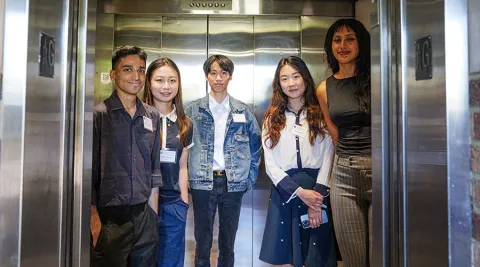
The Industry Capstone Program partners UW Engineering students with sponsor organizations to devise innovative solutions to real-world problems.
Capstone collaboration leads to award
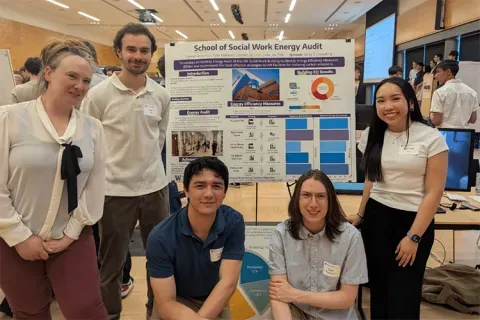
An ME capstone team received first place for its energy audit of the UW School of Social Work building.
Capstone creations
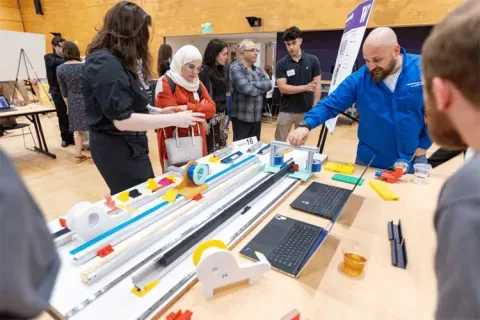
Students displayed innovative capstone design projects at the 2025 expo.