
Industry-Sponsored Student Capstone Projects
2025/2026
In the 2025/26 academic year the industry capstone program was supported by 83 sponsors, more than half of which were returning, and 116 real-world projects. Six hundred students from across the College of Engineering participated. Scroll down to learn more about each project.
Anatomic Innovations
Anatomically Designed Joint Supports
Existing ankle braces can be described as bulky, uncomfortable, and likely to restrict normal movement without providing enough support. This project aimed to create a close-fitting compression sleeve for the ankle that used built-in support features placed to match the body’s natural ligament structure. The goal was to help limit harmful motion linked to ankle instability while still allowing everyday movement. The concept also explored the use of newer materials and, potentially, sensors to improve how the brace responds during use. The intended result was a more comfortable ankle support that could meet testing requirements, with an approach that could later be adapted for other joints.
Bechtel
Marine Levee Design and Construction
Bechtel needed a reliable perimeter levee concept for a new industrial facility planned on a low-lying marsh site with difficult geotechnical and hydrological conditions and a high risk of flooding. The work focused on developing a 10,000-foot levee design in accordance with U.S. Army Corps of Engineers guidance, along with a construction sequence and supporting documentation for field execution. The proposed capability included levee layout and typical cross sections sized to address elevation, slope, settlement, factor of safety, design life, mitigation measures, cost considerations, and owner requirements. It also defined construction staging, inspection hold points, and weather-related considerations, and incorporated sediment and erosion control features to support Stormwater Pollution Prevention compliance. Together, these materials were intended to provide a buildable levee concept, clarify construction constraints and maintenance considerations, and enable the site to be protected from flooding before further facility construction proceeded.

BHC Consultants
Automation of Biological Nutrient Removal at the Mukilteo WWTF
The project addressed a need to reduce nitrogen in the final discharge stream at the Mukilteo Wastewater Treatment Plant by aiming to develop an automated controls strategy for secondary treatment. Using current and historical biological treatment data, the work was intended to develop a calibrated process model and evaluate control approaches that could fit within the plant’s existing infrastructure. The project aimed to produce a technical memo, preliminary process and instrumentation drawings, and a cost analysis to help assess potential operational improvements and savings.
BHC Consultants
Automation of Chemical Ortho-Phosphate Removal at the Arlington WWTF
The project addressed a need to reduce the amount of chemicals used to remove phosphorus at the Arlington Wastewater Treatment Plant. Although the plant already removed most phosphorus through its normal treatment process, it still relied on alum to keep phosphorus levels within permit limits when wastewater conditions changed. The work was intended to explore an automated control approach that could better adjust chemical dosing at key points in the plant using existing equipment and operating data. Planned outputs included a technical memo, preliminary process drawings, and a cost analysis to help assess potential operational improvements and savings.

Blue Origin
Evaluation of High Frequency Substrates for Antenna Designs
This project examined and compared different circuit board materials to determine which ones worked best for small wireless antennas. The antennas were designed to operate around 2.45 GHz, a common wireless frequency used by devices such as Wi-Fi and Bluetooth. This student team designed the antennas, simulated, tuned, fabricated and measured their performance in terms of return loss, gain patterns, Axial Ratio, and polarization, and compared the results. They evaluated the tradeoff between performance, cost, manufacturability, and the ease of design for each material. The goal was to identify a material that provided the best antenna performance while still being practical and affordable to produce.
Blue Origin
Optimizing Pack Cementation for Next-Gen Reusable Heat Shields
Blue Origin utilizes Carbon/Carbon (C/C) composites for flight-critical components because the material tolerates extreme temperatures in inert gas and vacuum, but it remains vulnerable to oxidation during atmospheric ascent, descent, and re-entry. To support lower-cost production of oxidation-resistant coatings, this project focused on improving understanding of the pack cementation process used to form a protective silicon carbide layer on C/C surfaces. This work builds on foundational experimental and analytical research by Prof. Mueller at the University of Washington, who developed earlier versions of these oxidation-resistant coating systems. The coating process embedded parts in a powder mixture of silicon, silicon carbide, alumina, and fumed silica inside a graphite retort, then heated the assembly above 1600°C to drive reactions that converted the surface to silicon carbide. As an initial phase, the project proposed thermogravimetric analysis with mass spectrometry to characterize mass change during heating, identify gaseous species released through the firing cycle, and determine critical temperatures associated with the underlying reactions. The student team worked to provide the thermodynamic and kinetic insight needed to better control and optimize the coating process.
Blue Origin
Temporary Aerospace Fastener Install Automated Tool
This project focused on the need for a simpler, lower-cost way to automate temporary fastener installation within robotic drilling and fastening systems used for launch vehicle structural assembly. The project aimed to design a compact installation tool for aero-structural components that can accept a temporary aerospace fastener, orient it correctly, insert it into a pre-drilled hole, and apply controlled torque to complete installation. The tool concept integrated mechanical, electrical, and controls hardware, including Siemens PLC-based torque control, and was designed to fit within a defined physical envelope for mounting on a larger automated robotic system. The design supports more cost-effective automated fabrication systems and provides a tool design that could potentially be replicated across automated assembly robots.
Blue Origin Club for the Future
Digital Postcard Enhancements
Blue Origin's Club for the Future sought to improve its digital postcard program across its website and self-contained kiosk platform used with museums and science centers, where the experience needed to better engage large public audiences while remaining accessible across devices and input types. This project focused on user-centered designs and simple prototypes for an upgraded postcard creation experience, including selectable color and photo backgrounds, branded stickers, enhanced drawing tools, improved menu icons and tooltips, and updated kiosk calls to action. It also explored enhancements to related touchpoints such as the online gallery and one-time “Flown to Space” email, along with an evaluation feature to gather user feedback, recommendations for safe use of AI image generation, and concepts for line-drawing “selfies” tied to a contest partnership. Together, these improvements make the platform more appealing to participants and partner institutions while extending the reach of the postcard experience for students, educators, and space enthusiasts.
Boeing
Boeing Small Single Aisle
With long-term demand expected to remain strong in the single-aisle aircraft market, this project explored what may be possible at the smaller end of that segment through a research aircraft concept. The project examined a single-aisle design sized for 110 passengers in a dual-class configuration with a 3,500 nautical mile range and a span within Code C limits. The student team considered how such a concept could compare with the Airbus A220-100, including a target of 7.5 percent lower block fuel per seat on a 1,000 nautical mile mission. The project produced a technical design study supported by relevant analyses and trade evaluations, along with a scale wind-tunnel model and experimental test results. Together, these results provided a research basis for assessing future possibilities in this portion of the market.
Boeing
Composite Material Recycling
Aerospace carbon fiber composites provide major performance and weight benefits, but managing composite waste remains an industry-wide sustainability challenge. This project addressed that limitation by exploring a circular use path for aerospace-grade composite waste at the UW Advanced Composites Center. Expired uncured slit tape tow remnants and out-of-spec spools were processed into a bulk molding compound, which was then formed into thin composite panels for inspection and mechanical evaluation. The project examined whether waste-derived material could be converted into a usable composite form and assessed panel quality, including visible flaws and material performance, for potential use in downstream consumer markets. This capability supported investigation of a more sustainable route for repurposing aerospace composite waste rather than treating it solely as scrap.
Boeing
Hydrostatic Pressure Enhancement of AM Polymers
Boeing was interested in whether hydrostatic pressure-based post-processing could improve the mechanical properties of additively manufactured polymer parts, particularly for thermoset materials. This project focused on developing and assessing a materials treatment approach for up to five AM polymers, using hydrostatic pressure-based processes to examine their effect on the base material. The work assessed material changes through methods such as sectioning and density measurement to determine whether the treatment could improve material quality. This capability was intended to provide a clearer understanding of the potential benefits of pressure-based post-processing for AM polymers and to support validation and quantification of any resulting material improvements.
Boeing
Laser Corrosion Removal of Aerospace Aluminum
The project addressed the need to assess whether laser ablation could be used to clean aluminum alloys by removing oxides and corrosion products without unacceptable changes to the underlying material. It focused on alloys in the 2000 and 7000 series and examined a range of corrosion conditions, including uniform, pitting, and filiform corrosion, to compare how effectively laser processing removed different types and severities of surface degradation. A test array of materials and oxide conditions was prepared, and laser parameters such as power, frequency, and scan speed were varied to study their influence on cleaning performance. The resulting specimens were characterized to evaluate both corrosion removal and the condition of the base material after treatment. Microscopy, scanning electron microscopy, cross sections, bend fracture observations, mechanical testing under different environmental conditions, microhardness measurements, and surface chemical analysis were used to assess residual byproducts, changes in morphology, and possible effects on material properties and microstructure. This work was intended to establish an experimental basis for judging the advantages and limitations of laser-based corrosion removal for aluminum substrates and to identify directions for future investigation.
Boeing
Life Cycle Assessment of Aerospace Paint Removal
This project addressed the need to better understand the environmental tradeoffs between conventional chemical paint stripping and laser "depainting" in aerospace applications, where coatings are removed for maintenance, repair, inspection, rebranding, and end-of-life processing. Chemical stripping has been widely used but involves formulations with significant environmental, health, and safety concerns, while laser depainting offers a potentially more sustainable alternative whose full impacts have not been quantified. This project aimed to develop a full life cycle assessment comparing chemical and laser depaint processes across upstream inputs, process operations, and end-of-life handling. This included consideration of factors such as stripper composition, laser equipment design, operating efficiency, personal protective equipment requirements, waste disposal, and effluent extraction. The project also included a literature review of chemical paint stripping practices and design considerations, along with a report documenting life cycle assessment inputs, results, and recommendations to inform future depaint system design and evaluation.
Boeing
Lightweight Composite Repair System with Expandables
Repairing structural composite parts often requires autoclaves or vacuum bagging to provide heat and compaction during curing, which makes small, localized repairs on large previously cured parts costly and disruptive. This project advanced a localized positive-pressure consolidation system intended to support composite repair without airtight sealing or a full autoclave return. Building on an earlier proof-of-concept, the project focused on a lightweight setup that could conform to curved aircraft-like surfaces using a flexible cover, anchoring features, pressure sensing, and a reaction support plate to resist the applied load. The system was intended to generate and control compaction pressure from expandable media at predetermined pressure and temperature conditions for repair scenarios such as co-bonding a metal and composite doubler. Initial coupon-level validation was pursued to assess the approach, with a stretch goal of using the system to fabricate composite parts for comparison with autoclave-cured and Double Vacuum Debulk methods.

Booz Allen Hamilton
Synthetic Training Data Generation for Side-Scan Sonar
Side-scan sonar (SSS) imaging is an acoustic imaging system used in underwater mapping and exploration, search-and-recovery, and environmental monitoring. Training sonar image recognition models requires a large volume of labeled SSS images, whose acquisition involves specialized hardware, crews, and lengthy field assignments. To address this, this team presented a synthetic data-generation system for SSS imagery in partnership with Booz-Allen-Hamilton. The solution is a physics-based simulator, built on the Unity game engine and grounded in the preeminent models of acoustic imaging, producing high-quality, automatically labeled SSS imagery that can accelerate sonar image-recognition model development.
Related News
Elevating emerging engineers
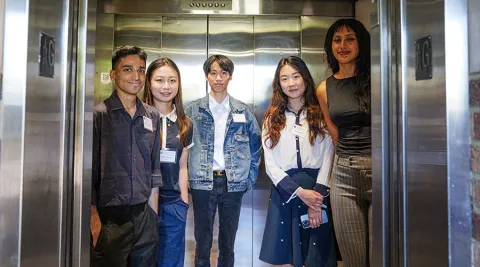
The Industry Capstone Program partners UW Engineering students with sponsor organizations to devise innovative solutions to real-world problems.
Capstone collaboration leads to award
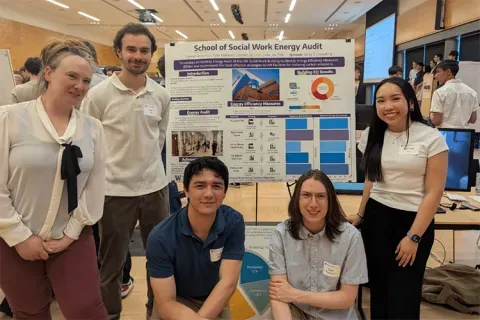
An ME capstone team received first place for its energy audit of the UW School of Social Work building.
Capstone creations
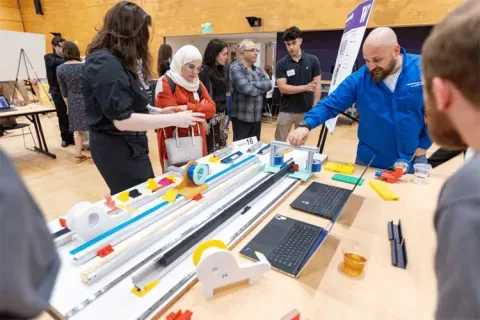
Students displayed innovative capstone design projects at the 2025 expo.