
Industry-Sponsored Student Capstone Projects
2025/2026
In the 2025/26 academic year the industry capstone program was supported by 83 sponsors, more than half of which were returning, and 116 real-world projects. Six hundred students from across the College of Engineering participated. Scroll down to learn more about each project.
Kohler
Integrated Cleaning System for Jetted Tubs to Improve Outcomes for Hospital Applications
Jetted tubs provide well-known health benefits, with pain management being one of the most commonly cited, and they are a popular noninvasive option in obstetrics because they do not require pharmaceutical intervention or invasive monitoring. However, hospital water systems can carry pathogenic bacteria such as Legionella, and current mitigation methods like periodic hot water flushes temporarily make tubs unavailable for use. This creates a need, in both hospitals and homes, for a low-maintenance way to keep jetted tubs clean with minimal user interaction. This student team focused on identifying cleaning technologies and operating conditions for a jetted tub cleaning system intended to work with minimal user interaction, avoid direct contact between the cleaning solution and the user, limit water use to less than 5 gallons per cleaning cycle, trigger automatically after a bath or after a set time period, and avoid degrading pumps or tub components. They aimed to produce a prototype concept for keeping a jetted tub system clean, along with findings on customer pain points, estimated costs, testing results, and material compatibility recommendations.
Lung Technologies
Therapeutic Incentive Spirometer with Digital User-Interface
This project addressed limitations in conventional incentive spirometers, which lack a standard way to monitor patient use and technique and require separate procedures for oxygen or albuterol administration. The work focused on a therapeutic incentive spirometer prototype that combined a mechanical spirometer, digital user interface, and integrated inhaler/administration port in one device. The proposed design reduced device size, improved handle ergonomics, repositioned the visual performance indicator, and added a port for oxygen and albuterol delivery. Its electronic interface was intended to track inhalation targets, detect diaphragm movement, display successful sustained maximal inhalation, count completed breaths, and provide reset, power, reminder, motion-sensing activation, and rechargeable power functions. The prototype was designed to demonstrate the fit, feel, form, and function of a market-ready medical device while supporting future evaluation of a more consolidated process for respiratory therapy and patient compliance tracking.
MarineSitu
Solar Powered Ocean Camera Buoy Development
The project focused on designing and prototyping a compact, solar-powered oceanographic buoy intended to operate an underwater camera and data transfer system for up to a year with minimal batteries. The buoy concept needed to integrate solar panels, onboard batteries, charge control electronics, a control computer, a camera, and a cellular antenna, along with a mounting frame designed with buoyancy foam, anchoring, and deployment and recovery pick points. The design also needed to target practical field use by keeping the buoy under 1 meter in diameter and about 100 pounds so it could be transported and deployed from a small vessel, while accounting for wave exposure, corrosion, and biofouling. Completion of the prototype enabled MarineSitu to evaluate it for long-term deployment and potential commercialization. This capability would enable persistent underwater ecosystem and biodiversity monitoring at marine conservation sites without cabling the buoy to shore for power.
McKinstry
Waste Heat to Warm Cities: Using Micro-Data Centers to Decarbonize Seattle
This project focused on the need to assess whether small, distributed data centers could support lower-carbon heating in Seattle’s dense urban core, where district steam and natural gas systems contribute significantly to building emissions. The student team explored micro-data centers as part of a block-level eco-district strategy, using recovered computing heat as a potential neighborhood energy source while supporting growing data center demand. The project focused on a candidate downtown block or building and examined heating and cooling loads, electrical demand and service capacity, and available space to assess feasibility. The resulting concept includes a block load model, preliminary sizing for the data center and core energy infrastructure, a plan for connecting recovered heat to nearby buildings, and an evaluation of potential energy and carbon benefits, with a conceptual economic review where feasible.

ORPC
Underwater Pneumatic Umbilical for Hydrokinetic Devices
This project focused on the need for a more reliable backup method for bringing variable-buoyancy air hoses to the surface in tidal and river energy systems, where strong currents, corrosion, sedimentation, marine growth, and limited access complicate maintenance. The student team developed a prototype Secondary Air Umbilical Unit intended to mount to existing equipment or provide standalone secondary hose storage. The unit needed to hold three 20-meter, 1/2-inch air hoses and release them when remotely triggered through ORPC’s subsea control and instrumentation interface, allowing the hoses to be retrieved at the surface. The design accounted for fresh and saltwater operation, flow speeds up to 2.5 m/s, depths up to 15 meters, repeated surface reset cycles, and minimal-maintenance operation without exposing sealed electronics. The prototype provides a testing platform for a more dependable secondary air-umbilical release capability in demanding marine energy environments.

Outdoors For All Foundation
Improved Wrist/Hand Paddle Adaptation
The project addressed the need for a paddle adaptation that provided greater range of motion while still allowing quick release in the event of a capsize. It explored an alternative to existing sliding mechanisms through a rotating ball-and-socket style concept intended to support more natural movement during use. The work also focused on a more user-friendly approach for attaching and adjusting the adaptation on the paddle, allowing full range of motion and with particular consideration for users with low or limited fine motor function. This capability aimed to improve both accessibility and ease of use while maintaining the safety requirement of rapid release.
P2S
JBLM Decentralization Design
This project consisted of developing conceptual designs to decentralize heating and cooling plants at multiple facilities at JBLM. The project addressed the need to evaluate and select building mechanical systems with stronger consideration for energy use, life cycle cost, and environmental impact. It focused on developing a mechanical design and assessment capability grounded in heat transfer, thermodynamics, and fluid dynamics to compare system options, perform load calculations, model energy performance, and identify opportunities to reduce or recapture energy. The work included system selection, design layout in CAD or BIM software where available, and supporting calculations, drawings, and reports, providing a structured basis for understanding facility mechanical design and its effect on carbon footprint.

PACCAR
Battery Pack Mechanical Mounting & Thermal Interface
The E-Truck Challenge began in late 2023 through a partnership with PACCAR to retrofit a Class 7 Peterbilt truck into an all-electric vehicle over four years. The effort grew to include a broader UW student engagement through a Registered Student Organization (RSO) focused on giving participants hands-on experience with industry components, software, and engineering practices while advancing cleaner transportation. Within that larger vehicle conversion effort, this capstone project addressed a need to integrate CATL battery strings into the truck architecture with secure mounting and safe connections to the cooling and high-voltage electrical systems. The students worked to define battery, high-voltage junction box, and S-Box locations and develop a complete design for mounting and connecting the battery system within the vehicle.

Tesla
Integrated Heating and Emissions Abatement System for Industrial Ovens
Automotive paint, e-coat, and powder coat ovens typically rely on standalone Regenerative Thermal Oxidizers to abate Volatile Organic Compounds (VOC) emissions, adding significant capital cost and factory space requirements. This project developed a conceptual integrated Regenerative Thermal Oxidizer (RTO) approach within oven heater boxes to reduce system complexity, cost, and footprint while supporting applicable NFPA, air district, and building code requirements. The concept used regenerative thermal oxidation as the basis of design, with targets for VOC destruction, thermal efficiency, cold-start readiness, and modular airflow capacity across different oven applications. The work defined the proposed system through engineering calculations, computational fluid dynamics (CFD) analysis, conceptual layouts, P&IDs, functional diagrams, a parametric 3D design, and a cost comparison against a traditional standalone abatement system.

UW Applied Physics Laboratory (APL)
An Underwater Robot for Attaching Recovery Lines
Retrieving objects from the seafloor is typically done by human divers or remotely operated vehicles, which makes the process costly, time consuming, and dependent on specialized operators. This project aimed to develop a prototype “smart hook,” an ROV-inspired module mounted at the end of a winch line that could help automate attachment to subsea objects before they were lifted to the surface. The concept focused on cooperative objects designed for retrieval by the system, with the hook lowered near an approximate known location and then using limited horizontal motion and visual homing to search for, approach, and attach to the target. The prototype was intended to include core autonomy and control functions, along with manual control modes for testing, using a reconfigured BlueROV platform and a hardwired tether rather than wireless communication. The system was intended to support faster testing and recovery of subsea scientific instruments, with future versions potentially extending to less structured objects such as subsea debris.
UW Applied Physics Laboratory (APL)
Profiling the Ocean for Health
Expendable conductivity-temperature-depth profilers (XCTDs) record salinity and temperature profiles across depths to assess ocean conditions. These single-use devices often cost thousands of dollars per unit, creating an economic barrier for oceanographic research. This team developed Ion-XCTD: a lower-cost platform that preserves core XCTD functionality, integrating UW-APL’s recently developed ion-potential-based salinity sensor, a depth sensor, and a temperature probe. Ion-XCTD houses its embedded system in a waterproof enclosure and collects data as it descends via a spooled tether. The collected data is sent up the tether to a floating buoy where, it is wirelessly relayed to a remote receiver.

UW Materials Science & Engineering Department
H2 Production System for Submarine Propulsion, Phase 2
In this project hydrogen generation through an aluminum-water splitting process was pursued as a clean energy option for transportation applications such as watercraft and submersibles, with a need to improve reaction control, propulsion integration, and economic viability beyond an earlier prototype. The student team worked to develop a mini-submersible or watercraft platform that uses hydrogen produced onboard to power a throttleable propulsion system. The project focused on studying the factors that influenced hydrogen production rate, creating a reaction chamber for controlled experiments, and designing a propulsion approach with sound fluid dynamic and material considerations to manage both gas flow and excess heat from hydrogen generation. The team produced a prototype that could demonstrate adjustable hydrogen production and variable-speed propulsion, enabling evaluation of this energy approach for practical marine use, including potential operation in seawater and assessment of its commercial feasibility.
UW Medicine, Emergency Medicine, RESCU Center
Crew-Centered Ergonomic Redesign for Critical Interventions in Aeromedical Transport
Airlift Northwest conducts more than 4,000 critical care transports each year, often in small, vibration-filled aircraft where space is extremely limited. Crews must deliver life-saving care—such as airway management, blood transfusion, and medication control—under challenging ergonomic conditions. Evidence shows that most in-flight patient deterioration occurs within the first 30–50 minutes of transport, making efficient, safe crew movement and access to equipment essential. Current cabin layouts prioritize aircraft operations, not human performance. This project aimed to redesign cabin workspace and equipment placement to improve ergonomics and safety for Airlift Northwest crews while maintaining aviation compliance. The work focused on studying crew motion and workflow in simulated in-flight conditions, identifying ergonomic barriers, and developing redesigned layouts or modular equipment mounts to improve reach, posture, and task efficiency. Physical or virtual prototypes were used to demonstrate the feasibility of these concepts and support recommendations for implementation.

Wave Therapies
Aquatic Wheelchair Redesign
This project focused on redesigning an aquatic wheelchair based on the current wheelchairs in use at the Bellevue Aquatic Center. The redesign needed to be cost-effective, reproducible, durable, functional, and comfortable to be used in a warm water therapy pool on a zero entry ramp. It also needed to fit on the pool ramp, through 36-inch doorways, and between the pool, locker rooms, and showers. The wheelchair needed to support up to 400 pounds, roll and turn smoothly with a seated user, provide stable support and relative comfort for nonambulatory users, reduce excessive buoyancy in the water, keep the user positioned safely as the ramp descends to 3 feet, and include functional wheel locks on both main wheels. The project resulted in open-source aquatic wheelchair plans and a prototype intended for use at the Bellevue Aquatic Center.
Related News
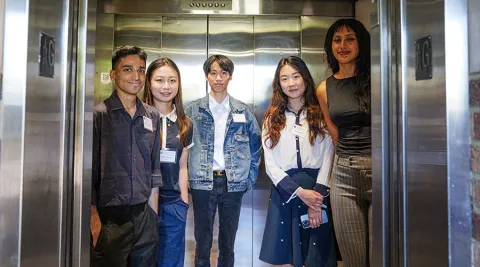
Elevating emerging engineers
The Industry Capstone Program partners UW Engineering students with sponsor organizations to devise innovation solutions to real-world problems.
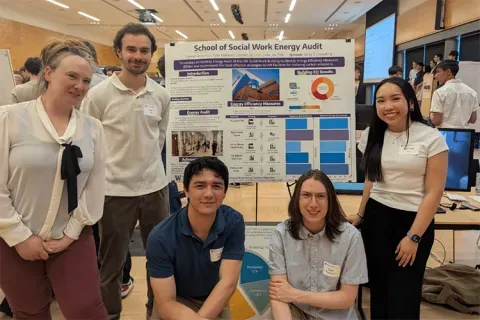
Capstone collaboration leads to award
An ME capstone team received first place for its energy audit of the UW School of Social Work building.
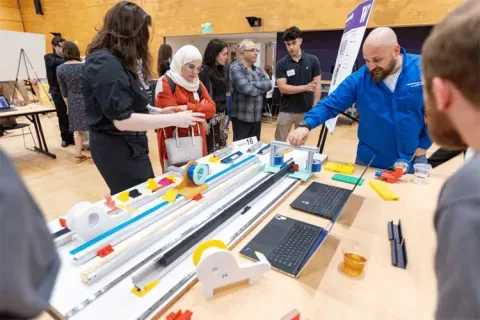
Capstone creations
Students displayed innovative capstone design projects at the 2025 expo.