
Industry-Sponsored Student Capstone Projects
2025/2026
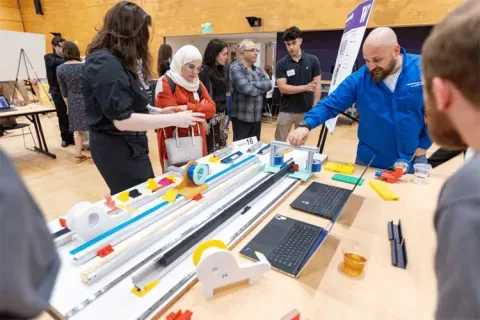
In the 2025/26 academic year the industry capstone program was supported by 83 sponsors, more than half of which were returning, and 116 real-world projects. Six hundred students from across the College of Engineering participated. Scroll down to learn more about each project.
BHC Consultants
Automation of Biological Nutrient Removal at the Mukilteo WWTF
The project addressed a need to reduce nitrogen in the final discharge stream at the Mukilteo Wastewater Treatment Plant by aiming to develop an automated controls strategy for secondary treatment. Using current and historical biological treatment data, the work was intended to develop a calibrated process model and evaluate control approaches that could fit within the plant’s existing infrastructure. The project aimed to produce a technical memo, preliminary process and instrumentation drawings, and a cost analysis to help assess potential operational improvements and savings.
BHC Consultants
Automation of Chemical Ortho-Phosphate Removal at the Arlington WWTF
The project addressed a need to reduce the amount of chemicals used to remove phosphorus at the Arlington Wastewater Treatment Plant. Although the plant already removed most phosphorus through its normal treatment process, it still relied on alum to keep phosphorus levels within permit limits when wastewater conditions changed. The work was intended to explore an automated control approach that could better adjust chemical dosing at key points in the plant using existing equipment and operating data. Planned outputs included a technical memo, preliminary process drawings, and a cost analysis to help assess potential operational improvements and savings.

Boeing
Life Cycle Assessment of Aerospace Paint Removal
This project addressed the need to better understand the environmental tradeoffs between conventional chemical paint stripping and laser "depainting" in aerospace applications, where coatings are removed for maintenance, repair, inspection, rebranding, and end-of-life processing. Chemical stripping has been widely used but involves formulations with significant environmental, health, and safety concerns, while laser depainting offers a potentially more sustainable alternative whose full impacts have not been quantified. This project aimed to develop a full life cycle assessment comparing chemical and laser depaint processes across upstream inputs, process operations, and end-of-life handling. This included consideration of factors such as stripper composition, laser equipment design, operating efficiency, personal protective equipment requirements, waste disposal, and effluent extraction. The project also included a literature review of chemical paint stripping practices and design considerations, along with a report documenting life cycle assessment inputs, results, and recommendations to inform future depaint system design and evaluation.
Crane Aerospace & Electronics
Vapor Degreaser Solvent Replacement
Crane Aerospace & Electronics needed a long-term replacement for Vertrel SFR after Chemours announced the solvent’s discontinuation. The project evaluated alternative cleaning solvents for vapor degreasing applications, with attention to compatibility with existing CAE equipment, electronic materials, and inspection requirements including IPC and MIL-STD criteria. Candidate solvents were reviewed and down-selected based on their ability to remove contaminants such as fluxes, solder pastes, oils, and greases without degrading materials already present in devices, including silicones, epoxies, and component coatings. The work produced a testing approach, material compatibility and cleanliness data, and a recommended replacement solvent path for further CAE validation.

JanuTech/UW Chemical Engineering Department
Synthesis and Technoeconomic Evaluation of Next-Generation Battery Materials
The project developed a technoeconomic and experimental evaluation framework for a 100 t/yr nanoparticle manufacturing process. The analysis estimated capital costs, annual operating costs, CO2e emissions, and material cost per kilogram while identifying major cost drivers in the baseline process. Alternative routes, such as reagent substitution or process modification, were evaluated for potential economic advantages and used to guide experimental nanoparticle synthesis. The resulting materials were intended for fabrication and testing in coin or pouch cells at the Washington Clean Energy Testbeds, providing proof-of-concept prototypes and supporting comparison of baseline and alternative manufacturing approaches.

Lockheed Martin
Ultrahigh Performance Composite Material
This project focused on a Phase 1 effort to support the search for resin formulations that could improve compression performance in carbon fiber reinforced polymer composites for weight-sensitive structures such as aircraft wings. The project focused on aerogel-and-epoxy systems as a possible route to co-continuous crosslinks associated with resin stiffness and toughness. The student team surveyed commercial aerogel products, compositions, manufacturers, and factors affecting nanoparticle crosslink formation, including surface chemistry, particle size, loading, and host material. The project also aimed to document crosslinks in a selected aerogel using microscopy and SEM, and to create a data-compilation method that could combine supplier datasheets and generated test data into a single structured table while identifying duplicate or equivalent property labels.

Membrion
Calculation of Cu Concentration in Industrial Waste Streams
One of Membrion's target markets is semiconductor and electrodeposition wastewaters. In-line metal concentration measurements of these streams are not straightforward due to fluctuations in the quality of customer waters. Conductivity and refractive index can be relatively straightforward measurements to determine metal concentrations, but are convoluted by changes in pH and turbidity. To address this limitation, the project investigated representative wastewater compositions relevant to Membrion’s target market and developed an experimental matrix of mixed-metal solutions containing copper salts, additional metallic salts, and acids. The solutions were characterized using conductivity, pH, turbidity, and refractive index measurements, and the resulting data supported development of a predictive model to estimate copper concentration from these more easily measured parameters. This work aimed to provide a calculator or software tool that could infer copper concentrations in complex process streams where direct measurement was difficult.

NC Clean Energy Technology Center (NCCETC)
Leveraging AI to Expand Home Electrification and Efficiency Incentive Data Access
Database of State Incentives for Renewables and Efficiency (DSIRE) is a leading source of information on policies and incentives that support renewable energy and energy efficiency, but its utility incentive data had been maintained through manual reviews of program websites. Because utility programs can change frequently, this approach did not always capture the latest information, and it limited coverage to utilities with 30,000 or more customers, leaving many smaller electric utilities outside DSIRE’s scope. To address this gap, the project developed an AI-based process to scan electric utility websites, identify text relevant to financial incentives, and extract key details about incentives for renewable energy systems, electrification devices, energy-efficient equipment, and building improvements. The effort produced a training dataset and a working model or application intended to help staff keep the system updated and support the addition of information from smaller utilities into DSIRE, expanding the potential to track incentive programs that were previously difficult to monitor at scale.
S2 Sustainable Solutions LLC
Micro/Nano-Bubble Delivery Mechanism of Ecologically Safe Agents for Burrowing Shrimp Control
Ghost shrimp burrowing in Willapa Bay and Grays Harbor damage oyster beds by causing oysters to sink and suffocate, and the pesticide control option, carbaryl, is now banned. In response to Washington state’s direction to research more sustainable pest management for shellfish growers, this project advanced a bubble-based delivery approach for shrimp control agents in saltwater environments. This work was conducted in collaboration with the University of Washington’s Pozzo Laboratory and Massa Products, a leader in ultrasound design and production. The system aimed to bind substances such as clove oil, PyGanic, or Chitosan to stable micro- and nanobubble emulsions that could move into shrimp burrows while oyster beds were submerged. Underwater ultrasound transducers were intended to collapse the carrier bubbles and release the agents directly into the shrimp habitat, enabling treatment at high water rather than only during rare low-tide conditions. The work focused on refining emulsion stability and reproducibility, preparing samples for ultrasonic bursting tests, and considering how the materials could be produced and supplied at a scale relevant to Washington’s oyster industry.
Related News
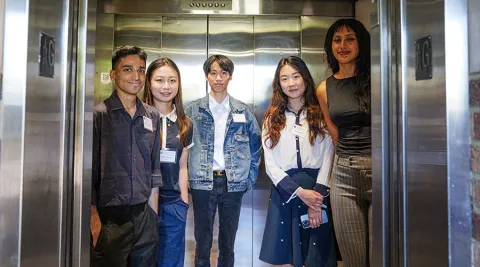
Elevating emerging engineers
The Industry Capstone Program partners UW Engineering students with sponsor organizations to devise innovative solutions to real-world problems.
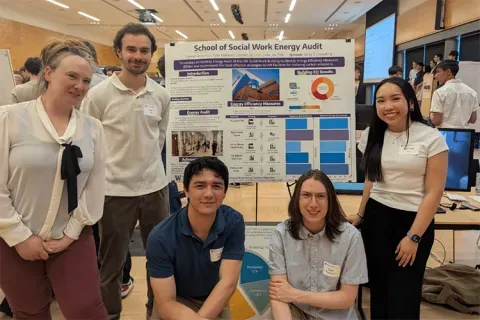
Capstone collaboration leads to award
An ME capstone team received first place for its energy audit of the UW School of Social Work building.
Capstone creations
Students displayed innovative capstone design projects at the 2025 expo.