
Industry-Sponsored Student Capstone Projects
2025/2026
In the 2025/26 academic year the industry capstone program was supported by 83 sponsors, more than half of which were returning, and 116 real-world projects. Six hundred students from across the College of Engineering participated. Scroll down to learn more about each project.
Adaptable House
Active Rest and Recovery: A Bed Mobility System
An athlete living with MS needed safer, more supportive ways to move, stretch, and exercise in and around a bed during periods of limited mobility, when getting in and out of bed and spending extended time in bed became especially challenging. The project explored a bed-adjacent mobility system intended to help a partially impaired user engage muscles and stretching while accommodating changing day-to-day needs, improving ease and security during bed transfers, and providing an aesthetic that felt calming and motivating. The work was aimed at producing a first-run prototype design and engineering concept suitable for future refinement toward a market-ready system.
Adaptable House
Ease of Use, Rest and Recovery: A Kitchen Mobility System
Because Multiple Sclerosis can cause day-to-day changes in physical capability, the sponsor needed a kitchen support system that could better accommodate mobility, stretching, and rest during routine meal preparation. The project developed a design concept for integrated kitchen assistance features intended to support activities such as accessing storage and refrigeration, washing and food preparation, cooking, cleaning, and waste disposal, while also providing immediate opportunities for resting and stretching. The concept considered overhead, wall-, counter-, and floor-supported elements, including fixed, pivoting, and movable configurations, to improve support and ease of use across a range of kitchen tasks. This work established an engineered foundation for future first-run prototyping of a more accessible kitchen environment.
Adaptable House
In-Home Overhead Mobility System for Adaptable House/Hanging Chair
Adaptable House Project needed a seating element that supported its integrated mobility system while remaining easy to use, compact when not in use, and visually appropriate for the home environment. This work focused on the design, build, and testing of a stowable "hanging chair" intended to provide a comfortable, playful, and aesthetically pleasing seating option that enabled the project’s full-support use mode. The effort produced design and engineering information to support creation of a full-scale working prototype, advancing a seating capability that could combine mobility support with simple operation and space-efficient storage.
Adaptable House
In-Home Overhead Mobility: Winch Design and 3D Demo
Adaptable House Project needed a cost-effective, reliable winching capability for an overhead mobility system intended to support people with changing mobility needs while encouraging physical movement and independence. To address this need, the project focused on the design of a scaled prototype winching system that could attach to an existing tabletop XY gantry and demonstrate key operating concepts for a future full-scale system. The resulting prototype was intended to show how a winch-based approach could support multiple modes of operation within the overhead mobility platform, and included controls developed to demonstrate basic system behavior.

Affiliated Engineers, Inc.
Preliminary Design for UW’s Steam System Isolation
As part of the University of Washington’s broader campus decarbonization effort, this project addressed a previously identified need in the Energy Renewal Plan to separate process steam loads from the central campus steam distribution system. The project focused on assessing steam process demand and site conditions for a specific group of buildings, with particular attention to MHSC, and developing a preliminary recommendation for how those loads could be served independently. The proposed approach considered the sizing of supplemental steam heating systems in relation to available space and electrical capacity, along with project cost estimates. It also evaluated emerging options for full or partial electrification of steam demand, including resistive heat, air-source heat pumps, and thermal energy storage, to identify a practical pathway for reducing reliance on the existing steam network and supporting future energy system decarbonization.
Amazon (Global Engineering, Maintenance & Sustainability)
Occupancy-Based Control (OBC) Prototype for HVAC Systems Using IoT Sensors
This student team designed and prototyped an Occupancy-Based Control (OBC) strategy for commercial building HVAC systems, addressing the limitation of fixed airflow and CO₂-based demand-controlled ventilation approaches that may not reflect true real-time occupancy. The design integrated commercial IoT presence and occupant-counting sensors with a mock building management system (BMS) to dynamically reset zone-level ventilation setpoints for spaces such as offices and break rooms served by HVAC configurations such as single-zone rooftop units or variable air volume systems. The prototype included a control concept, system architecture, simulated performance analysis, and a dashboard for viewing occupancy signals and ventilation setpoints. Lab and testbed evaluation focused on estimating potential energy savings, assessing indoor air quality performance against ASHRAE 62.1 ventilation requirements, and outlining how the approach could scale to commercial building applications without field deployment or custom sensor development.

Anatomic Innovations
Anatomically Designed Joint Supports
Existing ankle braces can be described as bulky, uncomfortable, and likely to restrict normal movement without providing enough support. This project aimed to create a close-fitting compression sleeve for the ankle that used built-in support features placed to match the body’s natural ligament structure. The goal was to help limit harmful motion linked to ankle instability while still allowing everyday movement. The concept also explored the use of newer materials and, potentially, sensors to improve how the brace responds during use. The intended result was a more comfortable ankle support that could meet testing requirements, with an approach that could later be adapted for other joints.

Blue Origin
Temporary Aerospace Fastener Install Automated Tool
This project focused on the need for a simpler, lower-cost way to automate temporary fastener installation within robotic drilling and fastening systems used for launch vehicle structural assembly. The project aimed to design a compact installation tool for aero-structural components that can accept a temporary aerospace fastener, orient it correctly, insert it into a pre-drilled hole, and apply controlled torque to complete installation. The tool concept integrated mechanical, electrical, and controls hardware, including Siemens PLC-based torque control, and was designed to fit within a defined physical envelope for mounting on a larger automated robotic system. The design supports more cost-effective automated fabrication systems and provides a tool design that could potentially be replicated across automated assembly robots.

Boeing
Hydrostatic Pressure Enhancement of AM Polymers
Boeing was interested in whether hydrostatic pressure-based post-processing could improve the mechanical properties of additively manufactured polymer parts, particularly for thermoset materials. This project focused on developing and assessing a materials treatment approach for up to five AM polymers, using hydrostatic pressure-based processes to examine their effect on the base material. The work assessed material changes through methods such as sectioning and density measurement to determine whether the treatment could improve material quality. This capability was intended to provide a clearer understanding of the potential benefits of pressure-based post-processing for AM polymers and to support validation and quantification of any resulting material improvements.
Boeing
Lightweight Composite Repair System with Expandables
Repairing structural composite parts often requires autoclaves or vacuum bagging to provide heat and compaction during curing, which makes small, localized repairs on large previously cured parts costly and disruptive. This project advanced a localized positive-pressure consolidation system intended to support composite repair without airtight sealing or a full autoclave return. Building on an earlier proof-of-concept, the project focused on a lightweight setup that could conform to curved aircraft-like surfaces using a flexible cover, anchoring features, pressure sensing, and a reaction support plate to resist the applied load. The system was intended to generate and control compaction pressure from expandable media at predetermined pressure and temperature conditions for repair scenarios such as co-bonding a metal and composite doubler. Initial coupon-level validation was pursued to assess the approach, with a stretch goal of using the system to fabricate composite parts for comparison with autoclave-cured and Double Vacuum Debulk methods.

Cascade Bicycle Club
Modular Bike Storage and Logistical Solution
Cascade Bicycle Club wanted to develop a safer, more efficient way to transport fully assembled bicycles in bulk from its South Seattle warehouse to schools across Washington. The existing approach relied on storing bikes and loading them one at a time into a 16-foot box truck, which limited capacity and added handling time. The project focused on developing a modular storage and loading system that would allow assembled bikes to be placed onto a rolling chassis in the warehouse, moved directly into the truck, and secured within the cargo bay for transport. The intent: to be operable by one or two people, support easy bike loading and unloading, and be durable, repairable, and replicable if unfinished. This capability aimed to combine storage and loading into a single process and reduce the labor and safety challenges of the club’s current shipping method.
EdgePerma: Pragtree Farm
Mobile Regenerative Agriculture Networked Chicken Coop
This project addressed a need for pasture-based poultry infrastructure that was easier to move, better suited to smaller farms, and compatible with diversified agricultural systems. Traditional mobile coops are often large, cumbersome, and dependent on tractors, which limits accessibility and increases labor, fuel use, and maintenance. The work focused on designing and prototyping a lightweight, mobile, predator-resistant chicken coop for use in pasture and silvopasture settings. The concept was intended to withstand environmental stresses, exclude common predators such as coyotes and raccoons, and support ergonomic use with cost-conscious, scalable construction for small- to mid-sized farms. A key aspect of the design was aligning the coop’s size and mobility with crop row spacing in orchard and agroforestry systems such as blueberries, apples, and hazelnuts. This approach was intended to let poultry move more seamlessly through working agricultural landscapes while supporting broader regenerative farming goals, including reduced fossil fuel dependence and improved integration of animal, crop, and ecological functions.

FEI Company (a part of Thermo Fisher Scientific)
AI Integrated SEM Imaging Analysis Workflow Development for Battery Manufacturing
This project addressed battery manufacturing characterization challenges by evaluating scanning electron microscope imaging and associated software features for automated SEM data collection and image analysis. The work focused on battery-relevant samples such as current collectors, cathodes, and anodes, with attention to imaging parameters including accelerating voltage, beam current, and field of view, as well as automation capabilities such as stage navigation, multiple regions of interest, and automatic acquisition. The evaluation aimed to provide validation and feedback on SEM workflows and AI-enabled tools, including Autoscript and ChemiSEM, for use cases related to throughput, defect detection, and microstructure analysis in smart battery manufacturing.

Hytek Finishes
Smart Beacon System for Industrial Process Optimization
Hytek Finishes currently uses manual beacons to communicate machine statuses; but these systems only provide basic visual signals and are found ineffective by workers. The existing system also fails to notify all relevant personnel of status changes. This project developed an integrated system featuring four-state industrial beacons and a touchscreen interface that combines visual indication, issue logging, and notifications while withstanding the plant’s harsh environments. Through its scalable design and integration with company servers, the system enables comprehensive issue tracking, enhancing communication, minimizing downtime, and supporting process optimization at Hytek Finishes.

IOActive Inc.
Develop a Motorized Angular Adjustment Head for a Mechanical Polishing System
This project addressed limitations in a mechanical polishing system that relied on manual, skill-dependent angular adjustments. It aimed to convert that process into a hands-free polishing platform by integrating motorized goniometer stages for tilt and theta adjustment, a motorized z-stage, and a Windows-based graphical interface. The system was intended to support very fine angular changes on the order of less than 0.01 degrees, provide variable sample loading from 20 g to 400 g, and guide operation through an intuitive interface that reduced the need for manual expertise. These results will provide a more reliable and accessible method for angular adjustment, along with a gentle, repeatable touchdown sequence designed to reduce the risk of sample damage during polishing.
Related News
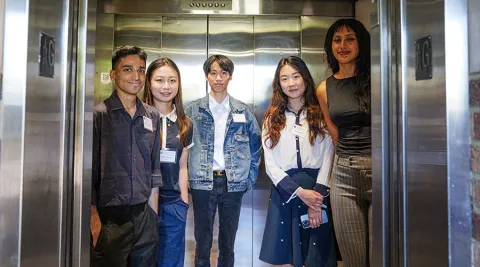
Elevating emerging engineers
The Industry Capstone Program partners UW Engineering students with sponsor organizations to devise innovation solutions to real-world problems.
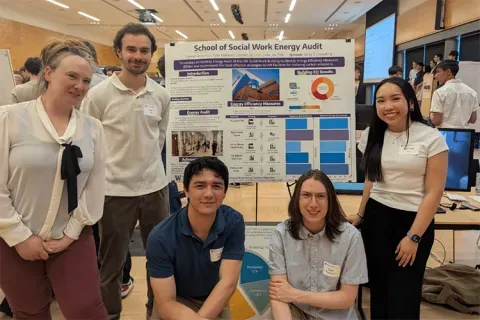
Capstone collaboration leads to award
An ME capstone team received first place for its energy audit of the UW School of Social Work building.
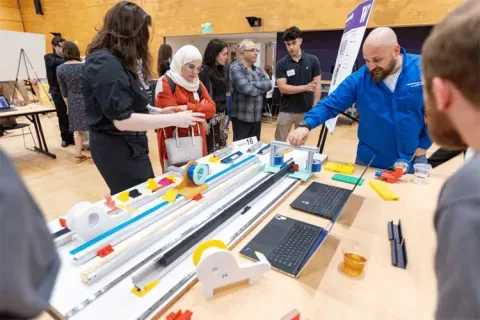
Capstone creations
Students displayed innovative capstone design projects at the 2025 expo.