Captivated by the mystery of space? Want to help revolutionize technology to enable exploration of the edges of the universe? Passionate about creating affordable and efficient options to move people around the globe? Want to learn to design satellites, missiles and other technologies to improve national security?
Related majors and academic degrees
academics applied learning profile research


Civil Engineering

Electrical and Computer Engineering
Mechanical Engineering
Keep exploring
Materials Science & Engineering
Consider specializing within your major
Concentrations, pathways, focus areas and degree options are all ways for you to specialize academically within your major. The specific policies and structures vary, but typically a specialization will involve a set of classes that all relate to one core theme. They may be either transcripted or untranscripted.
Transcripted: If completed, appear on your official UW transcript. These are generally competitive and require an additional application after you are in the major.
Untranscripted: Do not appear on your official UW transcript. Serve as guidance for students who wish to deepen their knowledge in a specific subject.
You can also explore the specializations offered by each department on our degree options page.
Choose meaningful general education courses
You can fulfill your general education requirements while building the context and creativity you'll need to engineer solutions to meaningful problems. Keep in mind that in your first year, you may want to start out in 100 or 200 level classes and build towards upper-division coursework throughout your time at the UW.
For example:
General education requirements
At the UW, you are required to take general education courses. As an engineering student, this can consist of:
- 10 credits of Arts and Humanities (A&H)
- 10 credits of Social Sciences (SSc)
- 4 credits of A&H or SSc
- 5 credits of Diversity (DIV)
Get involved!
Join student organizations working in your area of interest. You’ll make friends who have similar interests while building skills working on your passions. Participation in these organizations is not restricted by gender or other protected characteristics.
- American Institute of Aeronautics & Astronautics
- American Water Resources Association
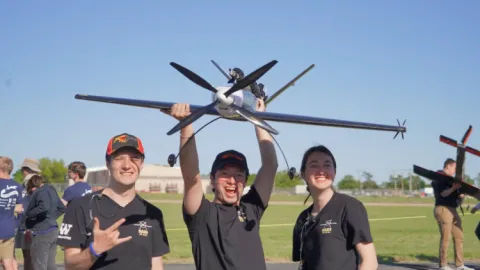
- Design, Build, Fly
- Society for Advanced Rocket Propulsion
- Women in Aerospace at the University of Washington
Study abroad opportunities
Deepen your understanding of the ways in which engineering can impact people around the world by participating in a study abroad program
Many study abroad programs include engineering classes, participation in research or internships. See UW Engineering's study abroad page to learn more and start the planning process.
Capstone design projects in air and space
In your final year, you will participate in a capstone design experience that serves as a culmination of your engineering study. Past capstone projects in air and space have included:
- Aeronautics & Astronautics and Electrical & Computer Engineering students designed an electronic angle-of-attack sensor to enhance autonomous landing capabilities
- Chemical Engineering students designed fire-fighting drones (SWARMFx) that could be deployed to forest fires as well as a paint additive (Polydrop)
See a full list of previous Industry capstone projects and a list of department-based capstone projects.
Join a research team
Every UW Engineering department offers undergraduate research opportunities. To get started:
- Ask questions and learn more at an Office of Undergraduate Research information session.
- Contact an adviser.
- Contact faculty to express interest in joining their labs and learn how to get involved.