
Membrion
Estimation of TDS Factors for Salt Solutions From Conductivity Versus Concentration Datasets
In engineering design, it is important to understand the constituents and chemistry of wastewater streams. The streams treated by Membrion's ECD technology are often complicated and lack qualitative and quantitative information. Conductivity is an easy measure of ionic composition but does not provide enough information about total dissolved solids. The student team will work to build a tool to predict total dissolved solids (TDS) factors for a range of individual and mixed salt solutions with varying concentrations and conductivities. The student team will: -Research composition of typical acidic wastewater streams in Membrion's target market. -Perform a literature survey to identify example stream compositions in semiconductor manufacturing, metal plating and finishing, and acid mine drainage industries. -Prepare an experimental matrix of different salts containing relevant ions having a range of concentrations. -Build a dataset of concentrations and their corresponding conductivities. -Build an empirical model to predict possible individual ion concentrations given the conductivity and species present in a wastewater stream. Optionally, use AI to further enhance model. The student team will work to create a tool/model/software that can predict TDS values from conductivity over a range of salt concentrations.
Faculty Adviser(s)
David Beck, Chemical Engineering
Related News

Elevating emerging engineers
The Industry Capstone Program partners UW Engineering students with sponsor organizations to devise innovation solutions to real-world problems.

Capstone collaboration leads to award
An ME capstone team received first place for its energy audit of the UW School of Social Work building.
Capstone creations
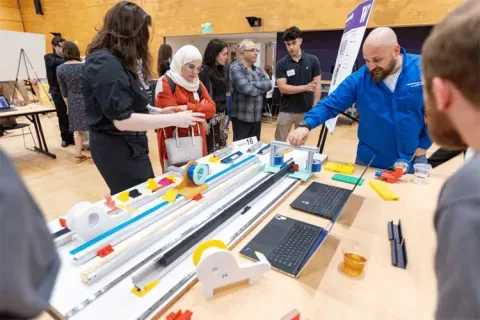
Students displayed innovative capstone design projects at the 2025 expo.