
Cyberworks Robotics
Deep Reinforcement Learning Path Planner for Self-Driving
Autonomous Self-Driving wheelchairs increase freedom and ease of mobility for the most vulnerable people in society. Cyberworks Robotics is the global leader in the design of such technology. Students worked on developing and optimizing cutting edge Machine Learning, Computer Vision and other technologies that push the envelope in the capabilities of such self-driving wheelchairs so that they can operate in ever-more complex environments. This project reimplements and evaluates deep reinforcement learning-based local planners (SACPlanner and a hybrid classical/RL planner) against a classical TEB baseline for autonomous wheelchair navigation. The system is integrated into the ROS1 Noetic navigation stack and validated in both Gazebo simulation and real-world wheelchair experiments. Evaluation scenarios include narrow corridors, dynamic obstacles, and localization challenges. Performance is measured using success rate, collision rate, trajectory deviation, and planning latency to assess robustness and sim-to-real feasibility, leading to a deployment recommendation for assistive wheelchair navigation.
Faculty Adviser(s)
Samuel Burden, Electrical & Computer Engineering
Related News

Elevating emerging engineers
The Industry Capstone Program partners UW Engineering students with sponsor organizations to devise innovative solutions to real-world problems.
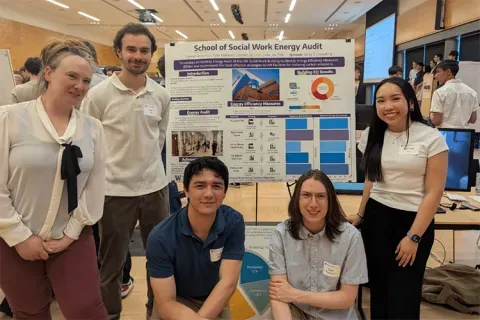
Capstone collaboration leads to award
An ME capstone team received first place for its energy audit of the UW School of Social Work building.
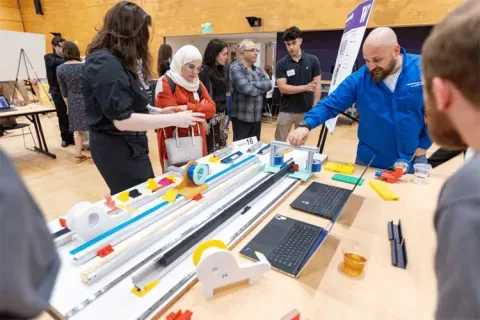
Capstone creations
Students displayed innovative capstone design projects at the 2025 expo.