
Blue Origin
Optimizing Pack Cementation for Next-Gen Reusable Heat Shields
Blue Origin utilizes Carbon/Carbon (C/C) composites for flight-critical components because the material tolerates extreme temperatures in inert gas and vacuum, but it remains vulnerable to oxidation during atmospheric ascent, descent, and re-entry. To support lower-cost production of oxidation-resistant coatings, this project focused on improving understanding of the pack cementation process used to form a protective silicon carbide layer on C/C surfaces. This work builds on foundational experimental and analytical research by Prof. Mueller at the University of Washington, who developed earlier versions of these oxidation-resistant coating systems. The coating process embedded parts in a powder mixture of silicon, silicon carbide, alumina, and fumed silica inside a graphite retort, then heated the assembly above 1600°C to drive reactions that converted the surface to silicon carbide. As an initial phase, the project proposed thermogravimetric analysis with mass spectrometry to characterize mass change during heating, identify gaseous species released through the firing cycle, and determine critical temperatures associated with the underlying reactions. The student team worked to provide the thermodynamic and kinetic insight needed to better control and optimize the coating process.
Faculty Adviser(s)
Luna Yue Huang, Materials Science & Engineering
Related News

Elevating emerging engineers
The Industry Capstone Program partners UW Engineering students with sponsor organizations to devise innovative solutions to real-world problems.
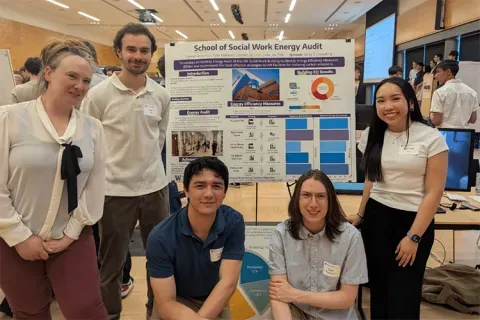
Capstone collaboration leads to award
An ME capstone team received first place for its energy audit of the UW School of Social Work building.
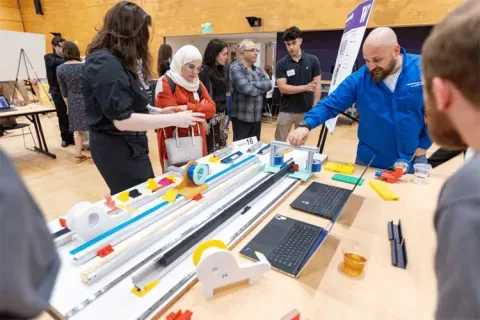
Capstone creations
Students displayed innovative capstone design projects at the 2025 expo.