
National Security Innovation Network (NSIN)
Wireless Embedded Sensor Monitoring
The National Security Innovation Network (NSIN) is a network in the U.S. Department of Defense (DOD), aimed at connecting DOD entities with academic and venture partners to innovate new solutions for DOD-member challenges. There are many off the shelf type sensors such as accelerometers, pressure transducers, flow, current, voltage and temperature sensors that operate in certain ranges and frequencies rates to output data. These sensors need to be installed at specific locations on the equipment or unit under test that requires many of them to be installed without obstructing the equipment operation. Wired sensors are a bit challenging to manage because of all the wires necessary to feed into a data acquisition system. Wireless sensors eliminate the challenges with wires but wireless must be secure enough to meet stringent cyber security requirements and be resilient enough to prevent attack or break down from usage. The form factor of the sensor would be embedded in equipment such that it is secure and rugged and can withstand the rigors of the environmental and operational conditions and not impede or interfere with equipment or process of operation. The wireless radio should be able to reach up to 200 feet from the equipment to the point of reception of the data and be of low power so that the battery can operate up to 10 years. The sensor(s) would be triggered when there is an event that occurs to activate the sensing quickly in less than 1ms. The sensor should be reasonably priced compared to similar sensors and readily available in the market place. This student team worked to build a small sensor that can fit into equipment form factor, be non-intrusive, and send out accelerometer/vibration data out at least at a 10KHz rate. This student team also worked to identify an interface that allows a wireless radio to be paired to a sensor and test the data rates that the sensor and radio can reliably perform and identify if the bandwidth of the radio is sufficient to handle the data needs of the application to collect all the data.
Faculty Adviser(s)
Payman Arabshahi, Electrical & Computer Engineering
Related News

Elevating emerging engineers
The Industry Capstone Program partners UW Engineering students with sponsor organizations to devise innovative solutions to real-world problems.

Capstone collaboration leads to award
An ME capstone team received first place for its energy audit of the UW School of Social Work building.
Capstone creations
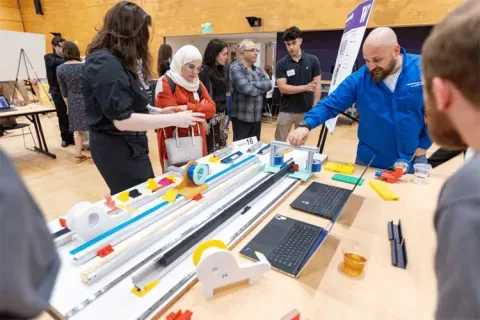
Students displayed innovative capstone design projects at the 2025 expo.