
By Ed Kromer
Immunology innovator Elizabeth Wayne pairs rigorous research with accessible outreach, bringing her bioengineering work to the people it’s meant to serve.
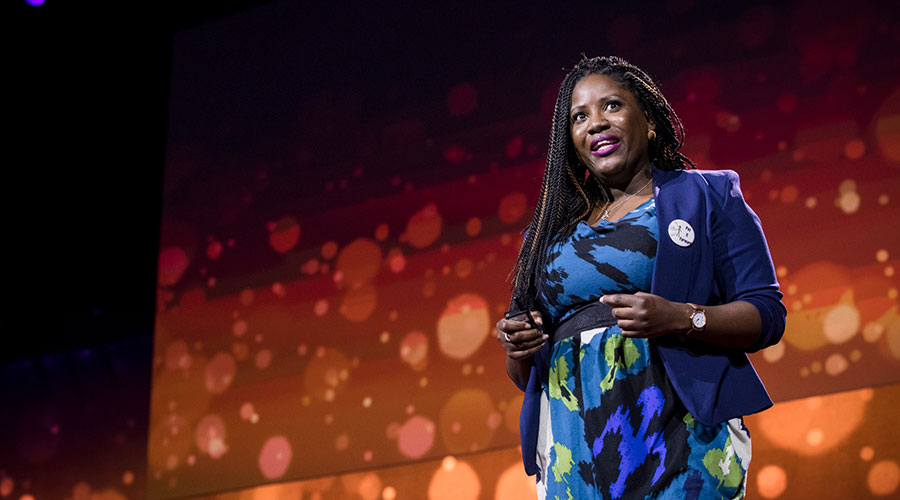
Elizabeth Wayne's 2017 TED Talk on hacking immune cells to fight cancer has more than 1.5 million views to date. Ryan Lash / TED
Elizabeth Wayne knows the power of “sticky balls.”
The BBC coined that evocative term to describe the immunology breakthrough revealed in Wayne’s first published paper, co-authored while she was a doctoral student at Cornell University.
The 2014 study was a big deal scientifically, introducing a drug delivery system that sends bundles of adhesive and cancer-killing proteins into the bloodstream, where the proteins hitch a ride onto circulating immune cells — effectively arming them to destroy the traveling cancer cells they naturally seek.
It was a big deal culturally, too. Though scholarly publications rarely travel outside academic circles, this one ignited a global frenzy in the popular media. Hundreds of articles unpacked the paper for audiences far beyond the discipline of bioengineering.
But the BBC’s pithy distillation of the study’s complex biological operation — “‘Sticky balls’ may stop cancer spreading” — made the biggest impression on a grad student just getting started.
“It was my introduction to the power of science communication,” says Wayne, now an assistant professor of bioengineering at the UW.
She has pursued that power throughout an early career equally focused on conducting rigorous research and conveying its value to the public it serves — through relatable podcasts, accessible advocacy and even an entertaining TED Talk on, well, sticky balls.
Immune system hacks
An unabashed science nerd since elementary school, Wayne’s academic career took off at Cornell, where she applied insights from physics to design more perceptive biological imaging technology.
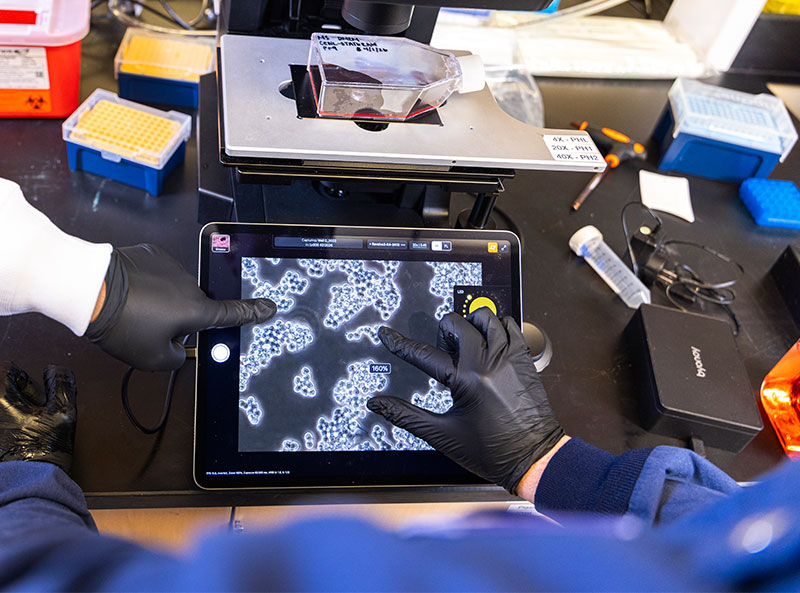
Macrophages grow in a cell culture dish, viewed under a brightfield microscope in the Wayne Lab. Mark Stone / University of Washington
A colleague named Michael King (now a professor at Rice University) approached her to help develop a novel way to mitigate metastatic cancer, which causes 90% of cancer deaths.
King envisioned attaching a tumor-reducing protein called TRAIL to the body’s macrophages — immune cells that hunt but can’t harm cancer cells. “If we can kill circulating tumor cells,” Wayne says, “then we can stop them from traveling to different parts of the body.”
Her experiments demonstrated just that: bundling TRAIL with an adhesive protein called e-selectin was remarkably effective at binding with macrophages in the bloodstream. These “sticky balls” adhered to cancer cells and killed them on contact. This became the blockbuster 2014 paper in the Proceedings of the National Academy of Sciences, attracting attention from the biomedical community and general public alike.
Wayne followed up with a study confirming that this technique significantly reduced the population of cancer cells throughout the body — in the original tumor, the bloodstream and remote organs.
Taking science to the masses
The success of these studies emboldened her to apply for a TED Fellowship. She had already begun engaging outside the lab at Cornell, organizing conferences and hosting a podcast called “PhDivas” that considered the many issues in the life of a graduate student.
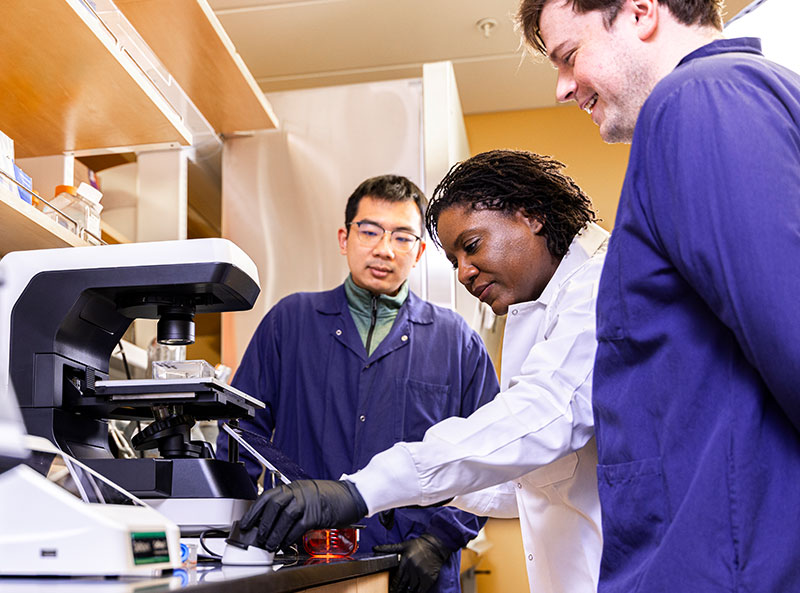
Elizabeth Wayne (center) views macrophages under a brightfield microscope with graduate students Jinting Liu (left) and Zachary James (right). Mark Stone / University of Washington
But when Wayne earned a coveted slot presenting at the 2017 TED Conference, an exponentially bigger audience awaited. After an intensive and surreal week of coaching and prep in the presence of Elon Musk, Al Gore, Serena Williams and other celebrities, Wayne delivered a TED Talk on hacking immune cells to fight cancer. The video has been viewed more than 1.5 million times.
The experience generated a level of celebrity she’d never imagined. There were speaking invitations, a book proposal and hopeful letters from cancer patients. But also criticisms from scholars in some corners of academia, who believe that time and energy spent on podcasts and TED Talks diminishes the serious business of research.
It was overwhelming. But after Wayne took some time to reflect on her future, she emerged with clarity and a renewed sense of mission: to operate with a dual focus on research and outreach.
“The tension is real, and understandable,” she says. “But I think about how to merge research and outreach into one common vision. It has become imperative to reinforce why scientists are needed and what is our value.”
America’s nerds
The value in Wayne’s lab is obvious. Her work has evolved from hacking immune cells for drug delivery to converting them into diagnostic — and even prognostic — tools. Funded by an R35 Maximizing Investors’ Research Award from the National Institutes of Health, she’s currently exploring whether bioluminescent molecules from fish and fireflies can be used to make macrophages “light up” in response to the earliest signs of disease.
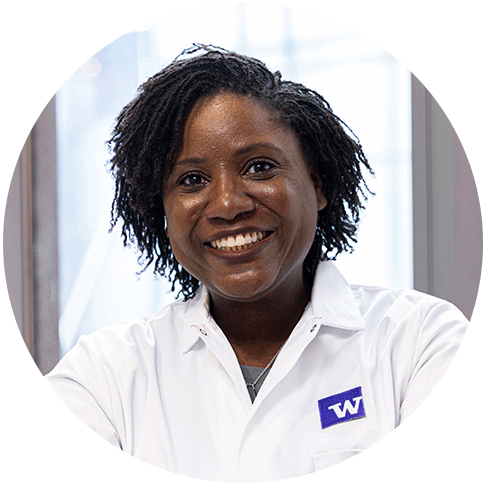
“I believe that engineers and scientists serve the public. We ask probing questions to solve important problems and train students who will make our communities better. We’re America’s nerds.”
And not just cancer. The promise of Wayne’s bioengineering is an organic system of surveillance and treatment for virtually any of the body’s myriad potential disorders. “We started with cancer cells,” she says. “But inflammation is everywhere.”
Wayne stays busy outside the lab, too, advocating for inclusion of women in STEM, engaging with cancer patients and survivors to inform her work and inspire her students, and translating research for the public. She has co-produced a TED-Ed video explaining how the COVID-19 vaccines were developed so quickly. And she’s once again behind the microphone, this time shining a light on the contributions of fellow researchers through her “Office Hours” podcast, a partnership with the American Biomedical Engineering Society that intends to humanize the engineering behind everyday biomedical applications.
“I feel like I’m inventing a new way to be a public scientist,” she says.
She increasingly views research and outreach as her yin and yang — complementary and interdependent forces that create human connection, provide purpose, ensure relevance and generate visibility that is essential to funding her work and supporting her students’ development.
It’s also a constant reminder that the heart of bioengineering is human.
“I believe that engineers and scientists serve the public,” says Wayne. “We ask probing questions to solve important problems and train students who will make our communities better. We’re America’s nerds. I’m your nerd.”
Watch Wayne's TED Talk:
Originally published May 18, 2026