
AI tools are reshaping nearly every field — including engineering. To meet the growing demand for engineers who know how to integrate these tools into their practice, the College of Engineering has launched two new professional programs — a graduate certificate and a master’s degree — in AI and machine learning (ML) for engineering.
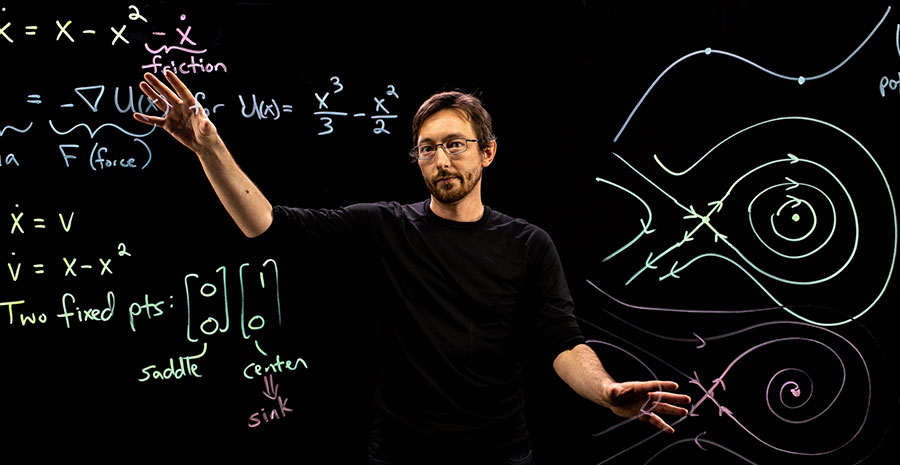
Steve Brunton, director of the AI and ML for engineering professional programs. Dennis Wise/University of Washington
We sat down with Steve Brunton, a professor of mechanical engineering and the programs’ director, to find out what makes them unique and why the time for them is now.
Who should consider these professional programs?
They’re designed for working engineers who want to add AI and ML to their existing expertise, and they’re great for students right out of undergrad, too. We see applicants from a wide range of fields. Some are early-career engineers looking to expand their technical toolkit. Others are experienced professionals who want to lead teams integrating AI into complex systems. They come from aerospace, chemical manufacturing, health care, e-commerce, energy and beyond. What all of our students share is a desire to apply AI smartly and safely to real engineering challenges.
Why did you and your colleagues create them?
We recognized a gap between what’s typically taught in classrooms and the cutting-edge research on applying AI in engineering contexts. General AI tools can be helpful for things like explaining a concept, writing an email or making a travel itinerary, but they’re not intended for designing airplanes or the bridges you drive over every day. Engineers need to learn AI that's built specifically for engineering — because the margin for error in the physical world is essentially zero.
Learn more about AI and Machine Learning graduate programs
Applications for fall 2027 open in January.
What are students working on?
We have engineers working on safer aircraft — improving control systems, inspection methods and warning systems. Others are using AI to optimize manufacturing processes and improve worker safety. One engineer is developing automated food spoilage detection. Others are tackling offshore wind energy and fusion. We also have students applying these techniques to medical physics and advanced imaging.
What do students learn, and how can they tailor the programs to their field?
Students gain both the technical skills and the judgment to apply AI responsibly in engineering settings — how to choose and implement the right methods, evaluate results and recognize the limitations of these technologies. The programs also sharpen the mathematical and coding skills engineers need to keep pace with rapidly evolving tools. On the flexibility side, these programs are part of the College’s stacked master’s degree structure. Students earn the AI and ML certificate and then pair it with a second affiliated certificate in an area that aligns with their interests. Add a capstone project, and they’ve earned a professional master’s degree — one they’ve shaped around their own career goals.
How do these programs prepare engineers to use AI responsibly, and what does that mean for their careers?
One of the best ways to use AI responsibly is to truly understand it. These programs demystify AI tools for engineers, teaching them how to approach AI systems as they would any engineering system — by understanding how the systems work and how to evaluate their limitations. That foundation is what allows engineers to certify, deploy and manage AI technologies in ways that prioritize safety and reliability, not just technical performance.
That approach mirrors what industry is looking for right now. Every sector is investing in AI, and companies need engineers who combine deep domain expertise with a strong understanding of AI systems. On a day-to-day level, engineers who complete these programs will work smarter, tackle more complex problems and be better positioned to lead. The goal, ultimately, is for AI to be a tool that makes engineering better — so we can do our jobs better and to make the world a better place through engineering.
Originally published April 27, 2026