
By Ed Kromer
UW researchers are leading the development of nuclear fusion, harnessing the power of a manufactured miniature sun to meet the exploding demand for sustainable energy.
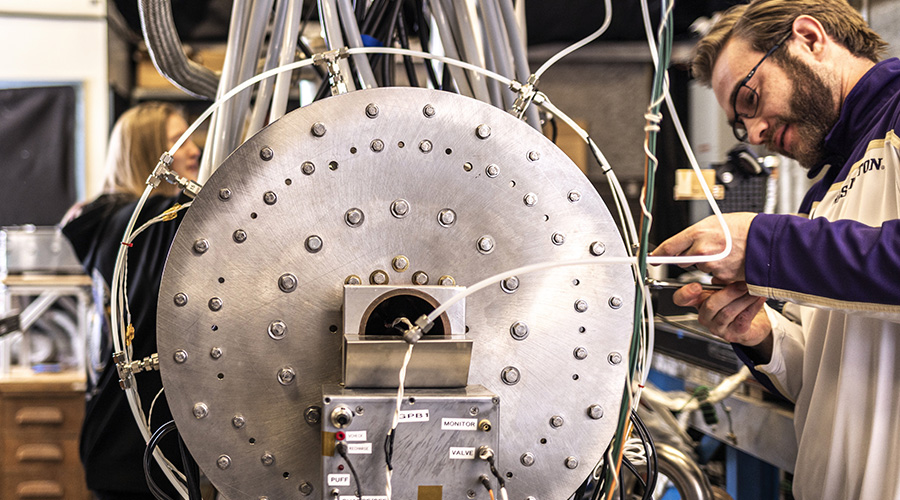
Graduate student Jared Smythe (right) and undergraduate Kirsten Alderson (left) work on the ZaP-HD fusion energy development device in the UW's Flow Z-Pinch Lab. Mark Stone/University of Washington
Uri Shumlak was just a kid working at a Houston gas station in the mid-1970s when the OPEC oil embargo forced drivers to queue for hours in hopes of filling their tanks.
“I saw the desperation of people begging for gas after we had reached our daily quota,” he recalls. “I thought, there has to be a better way to produce energy.”
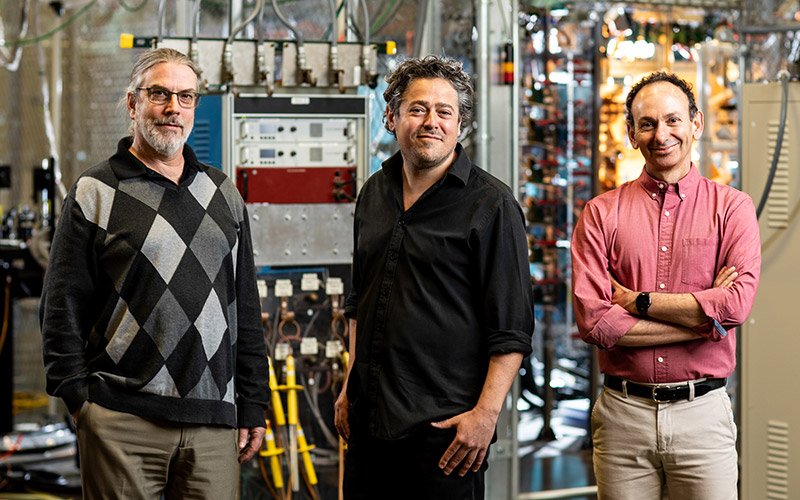
UW professors Brian Nelson (left) and Uri Shumlak (right) co-founded Zap Energy with inventor Benjamin Conway (center). Zap Energy
Shumlak has devoted his career to finding it. The professor of aeronautics and astronautics is a leader in the development of nuclear fusion, perhaps the best alternative to fossil fuels to meet humanity’s exploding demand for energy.
He says fusion energy — extracted from fusing atoms in superheated plasmas — offers a long list of virtues.
It emits no greenhouse gases and produces no long-lived radioactive waste. It has the potential to generate vast amounts of power from abundant fuel drawn from seawater. And, unlike existing renewables, it could scale to meet global demand.
Most of all, fusion is forever, according to Bhuvana Srinivasan, Shumlak’s former student and current faculty colleague.
“If we can achieve fusion,” Srinivasan says, “we can solve the energy problem to perpetuity.”
Of course, there are a few details to work out first.
In the superheated soup
As a concept, fusion energy is as awesome as it is audacious.
Shumlak, Srinivasan and researchers around the world are endeavoring, essentially, to create and contain a miniature sun — a star in a jar — and harness its energy to power modern life.
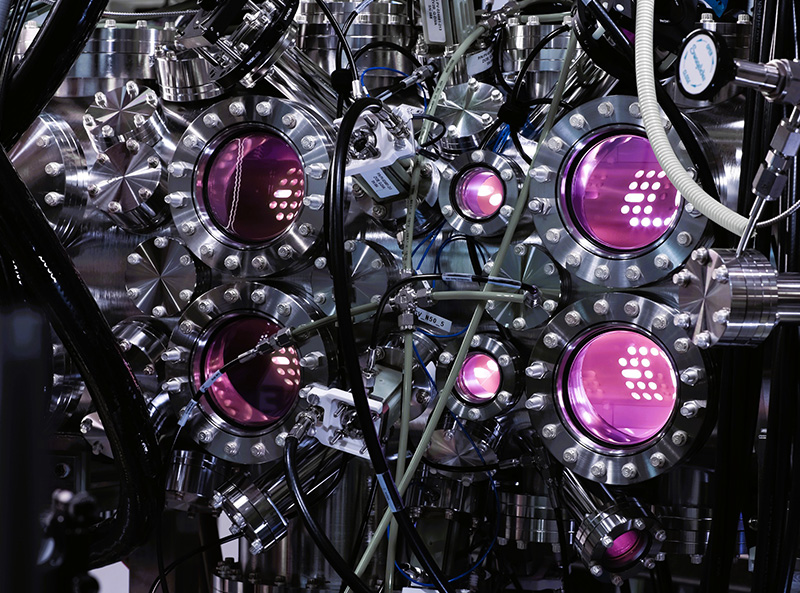
Magenta-hued plasma pulses provide the conditions for a fusion reaction in high-tech devices. Zap Energy
The process begins by generating stellar levels of heat. “With the technological innovations that the field is driving, we’re now able to create temperatures hotter than the core of the sun in the laboratory,” says Srinivasan.
This superheating creates plasma, a state of matter best described as an atomic soup. Extreme temperature and pressure enable positively charged nuclei, such as common hydrogen isotopes, to overcome their physical repulsion. And when two nuclei fuse into one, enormous energy is released in the form of alpha particles and neutrons.
The challenge is in confining plasma and capturing the product of its fusion.
Containment strategy
The sun accomplishes this with its massive gravitational force. On earth, however, researchers need to finesse physics to confine plasma. Shumlak has long experimented with a magnetic method called the Z-Pinch.
In his Flow Z-Pinch Lab, students tinker with a Frankenstein-ed device of conjoined metal cylinders speckled with welded portals and tethered to capacitors by a tangle of hoses and wires. Its steampunk vibe feels entirely appropriate to this effort to turn science fiction into reality.
Inside the ZaP-HD fusion chamber, an electric current runs through an accelerated flowing plasma, enveloping it in a stable magnetic force field. The stronger the current, the tighter the compression — until it reaches sufficient heat and pressure to fuse nuclei.
“If you compress plasma to the point where density and temperature are high enough,” Shumlak says, “it will fuse.”
More advanced equipment is deployed at Zap Energy, the spinoff company that Shumlak co-founded with longtime collaborator Brian Nelson, an emeritus professor of electrical and computer engineering, and inventor Benjamin Conway.
With nearly $350 million in private and public investment, Zap is enhancing the production and frequency of plasma flows and using liquid lithium to convert the hailstorm of neutrons from a fusion reaction into steam that can produce grid-ready power. The company plans to deliver this via compact, modular reactors, each capable of generating 50 megawatts of electricity — enough to power a small city.
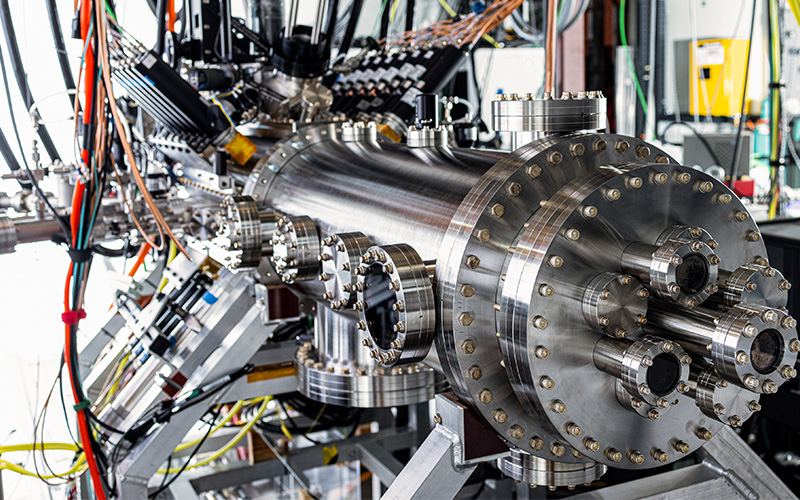
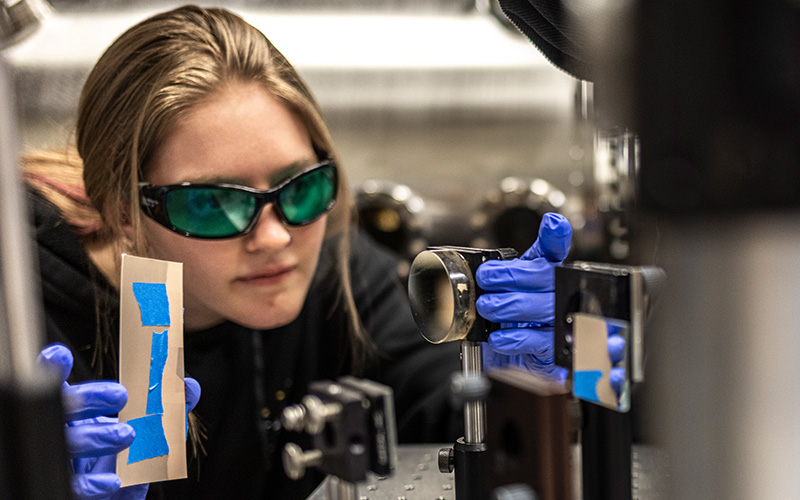
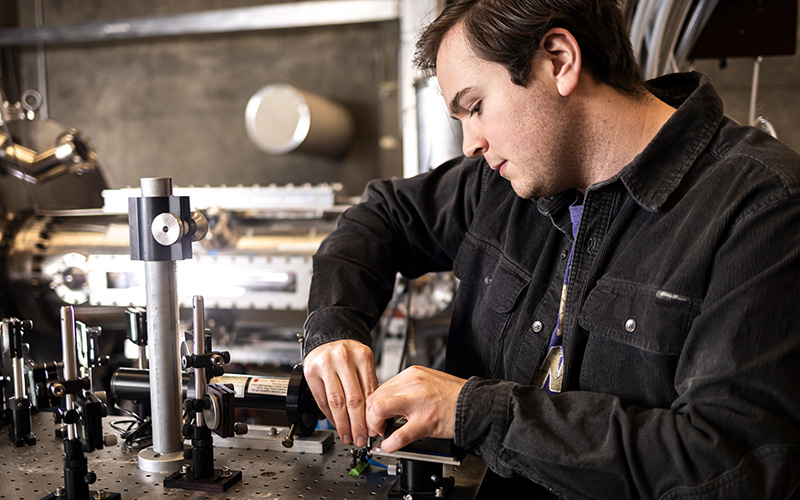
Zap Energy's FuZE-Q device (left) is a higher-power and more advanced iteration of the UW's Zap-HD in the Flow Z-Pinch Lab, where students like Kirsten Alderson (top right) and Elliott Montoya (bottom right) experiment and learn plasma physics under the guidance of Uri Shumlak. Zap Energy and Mark Stone/University of Washington
Ecumenical support
While Zap pursues a particular path to fusion, Srinivasan supports a wide range of efforts and approaches.

Bhuvana Srinivasan leads the UW PLASMAWISE Laboratory. University of Washington
Her PLASMAWISE Lab creates computational models and measurements for concepts being developed at the UW, Princeton and several national labs. She says the “high-fidelity physics” behind their simulations guide experimentation and diagnostics — often with superior efficiency and precision.
“If you run a whole series of experiments, you may not have the ability to construct the full picture. If you run a whole series of simulations, you may never capture the real world,” Srinivasan says. “But a combination of the two validates what’s really happening.”
The race to fusion
When it comes to fusion energy, the trillion-dollar question remains: when — if ever — will this technology deliver?
“When I was a grad student, the joke in my field was that fusion is always 30 years away,” Srinivasan says. “Now the joke is that fusion is always 10 years away.”
What may soon kill this joke, she says, is the extraordinary research and development underway at massive international projects such as ITER and a constellation of national labs and universities — and in the clusters of startups forming around them. Washington’s robust fusion ecosystem represents a large chunk of the nation’s nascent industry, led by Zap and Helion Energy, which was co-founded by aeronautics and astronautics Ph.D. alumnus George Votroubek.
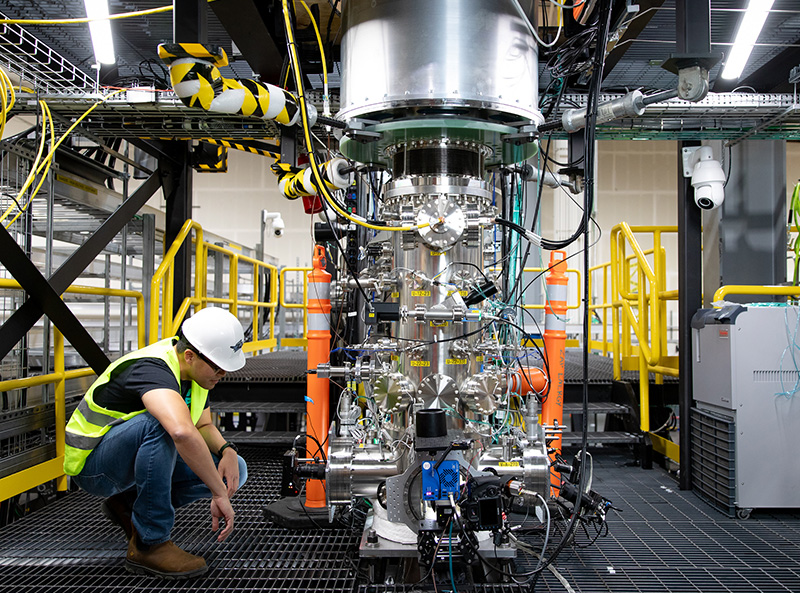
Zap Energy experiments with numerous challenges of containing fusion energy on its Century device. Zap Energy
Though many scientific and engineering problems remain to be solved, researchers are producing regular breakthroughs, most notably the first fusion “ignition” at Lawrence Livermore National Lab in 2022, when more energy was extracted from fusion than it took to produce it.
Fusion’s timeline depends on science, engineering and funding by government, universities and conscientious (or opportunistic) investors. And on the commitment of researchers like Srinivasan and Shumlak and generations of their students, who are all in.
“I don’t know when it’s going to happen,” Shumlak says. “But I believe that fusion energy is going to be necessary for us to move forward as a civilization. That’s a cause worth devoting my career to.”
It’s why the race to this technology may be more collaborative than most.
“We need fusion energy,” Srinivasan says. “Whoever gets there first, it will be a huge win for humanity.”
Read more engineering innovation stories
UW Engineering faculty and students in every discipline are taking on humanity’s grand challenges with inventive solutions.
Originally published March 16, 2026