
By Ed Kromer
The decade-long Boeing Advanced Research Collaboration is forging the future of flight — and providing a new model of strategic academic-industry partnership.
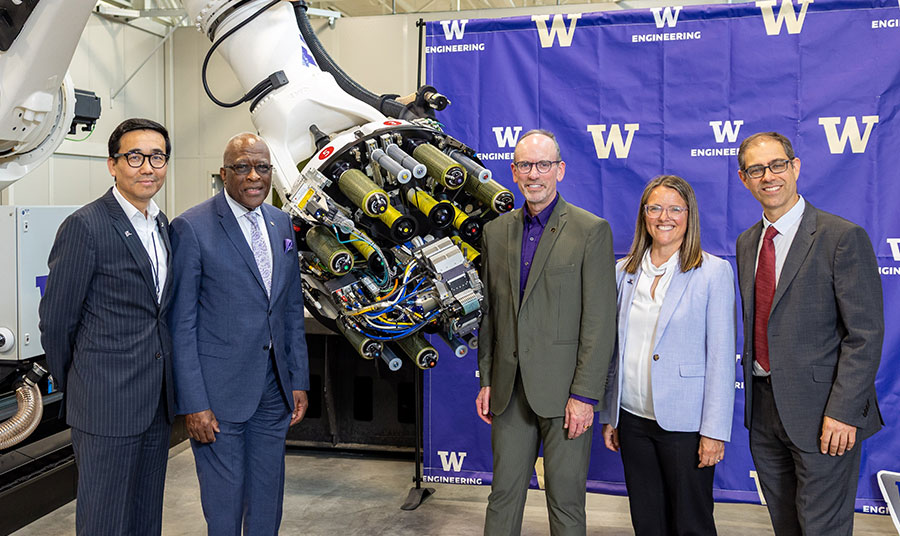
UW Engineering Vice Dean Jihui Yang, UW President Robert J. Jones, Boeing partners Steve Chisholm, '86, and Michelle Carey, '01, and Mechanical Engineering Chair Alberto Aliseda celebrate BARC's first ten years. Photo by Matt Hagen
Robotic ultrasound technology that detects hidden defects in composite parts. A testbed that measures the dynamics and sensitivities of air flow around wings during stalls. A zipper-like mechanism that wraps high-tech sleeves around the seams where aircraft components meet.
These are just a few of more than 100 innovations developed during the first ten years of the Boeing Advanced Research Collaboration (BARC), a different kind of academic-industry partnership.
Originally established in 2014, the BARC is a strategic initiative that pairs Boeing engineers with UW Engineering faculty and students from multiple disciplines to develop a suite of technologies animated by a single, ambitious question: what will the future of flight require?
“BARC is not the typical sponsor-contractor type of relationship,” says Xu Chen, BARC director and associate professor of mechanical engineering. “The technologies we develop together — whether a method, algorithm or system — are often implemented in the factory and create significant impact.”
The power of people in partnership
Applied and foundational research projects focus on a variety of areas, from robotics and automation; to advanced materials, aerodynamics and fluids; to quantum technology, data science and augmented intelligence.
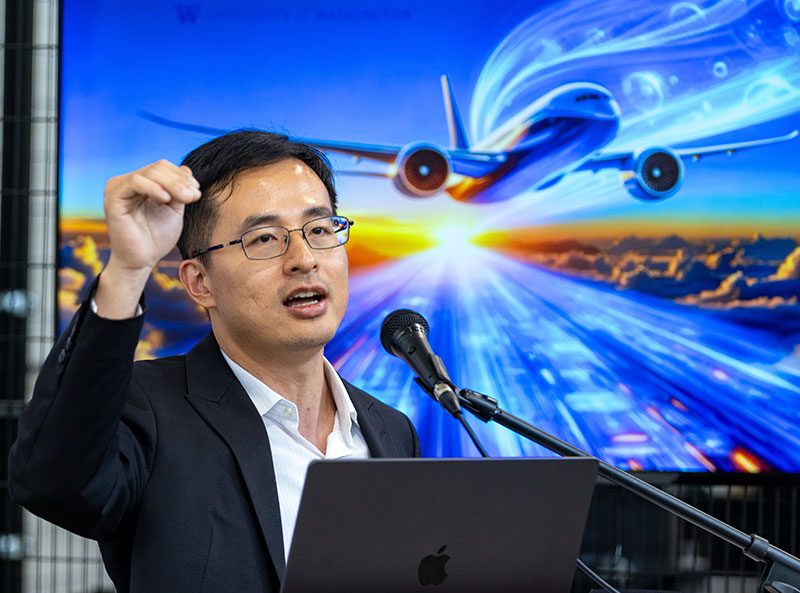
BARC Director Xu Chen speaks at the program's 10th anniversary celebration. Photo by Matt Hagen
It’s people who set these projects apart, according to BARC co-founder Steve Chisholm, vice president and chief engineer for Boeing Mechanical and Structural Engineering.
“What makes BARC special is the depth of the collaboration,” he says. “This isn’t simply Boeing funding research at a university. Boeing engineers work alongside UW faculty and students, bringing together different perspectives, expertise and capabilities to address shared technical challenges.”
This creates a unique exchange.
“Students and researchers gain exposure to real-world aerospace challenges and experienced Boeing engineers, while our teams benefit from the creativity, research expertise and new ideas coming out of one of the country’s leading engineering institutions,” Chisholm says. “Our proximity helps accelerate research and innovation.”
An exemplary collaboration
Chen adds that Boeing’s long-term commitment creates a pipeline of industry-ready students — many BARC alumni are among the 8,000-plus UW grads working at Boeing.
One of them is Megan Taylor-McCauley, ’23, who worked on two BARC projects while earning her master’s degree in mechanical engineering, leading to her current job as a materials, processes and physics engineer at Boeing.
“The BARC experience has meant the world to me,” says Taylor-McCauley, who now mentors students in BARC. “I went to graduate school to get more hands-on experience before I entered the workforce. BARC gave me the exact skills I needed to be successful in engineering and the relationships to help me continue to grow and develop further in my career.”
BARC also attracts top-class faculty from multiple disciplines who provide cutting-edge research expertise and also develop professional education programs, such as the new professional graduate programs in AI and machine learning for engineering and in interdisciplinary robotics.
As this commitment is renewed for the next ten years, BARC is not only advancing the aerospace industry. It’s also providing a blueprint for strategic collaboration with partners in any industry.
“Our Boeing collaboration is exemplary. What began as a bold vision has grown into a model for the College of Engineering,” says Nancy Allbritton, Frank & Julie Jungers Dean of Engineering. “By translating innovations into impact and investing in the next generation of engineers through applied research and workforce development, we are advancing the future of flight. We hope this success inspires similar partnerships with other companies and industries.”
The Boeing Advanced Research Collaboration
The Boeing Advanced Research Collaboration (BARC) brings together Boeing engineers, UW Engineering faculty and students, and researchers from other disciplines to work on joint projects that address the challenges and opportunities of aircraft manufacturing.
The collaborative umbrella for research between Boeing and the UW houses the BARC Lab, formerly known as the Boeing Advanced Research Center, where innovative solutions for the factory floor are developed and tested. BARC also includes the Boeing Data-driven Engineering Education & Research Initiative and industry capstone projects, and it pursues new sponsored programs for research, education and workforce development.
Originally published October 22, 2026