
By Ed Kromer
The UW + Amazon Science Hub facilitates research collaborations that accelerate practical innovations in robotics, AI and much more.
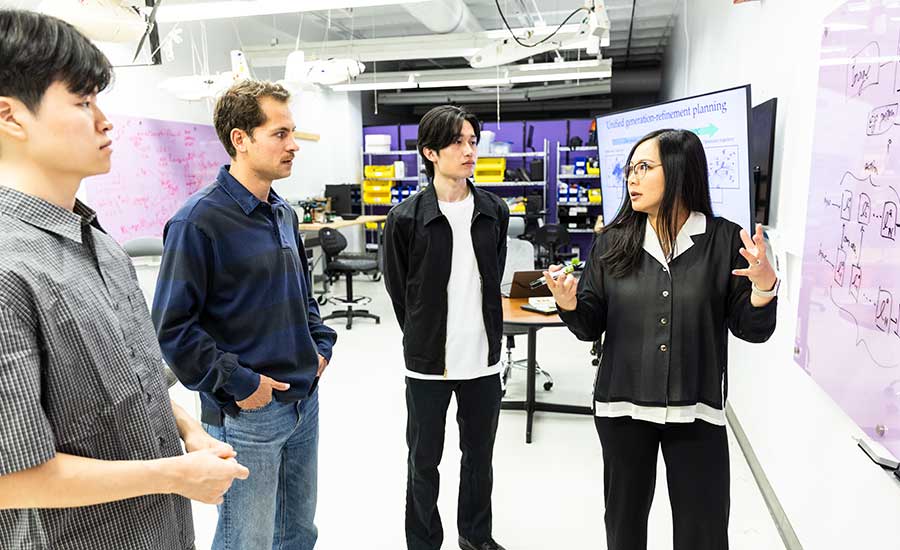
UW + Amazon Science Hub Director Karen Leung (right) and students in her Control and Trustworthy Robotics Lab are developing safe, intelligent and dependable autonomous systems. Dennis Wise / University of Washington
In addition to a curious mind, Jake Gonzales has an impeccable sense of timing. A doctoral student in electrical and computer engineering, his interest in making complex AI systems, such as robotics, operate more safely and efficiently coincided with the first years of the UW + Amazon Science Hub.
The Hub was created in 2022, with an investment from Amazon, to support strategic research directions at the convergence of UW and Amazon strengths and expertise.
Through the Hub, Gonzales was awarded an Amazon Ph.D. Fellowship to develop large-scale deep learning models that orchestrate the hundreds of thousands of mobile, autonomous robots that work alongside humans to fulfill orders in Amazon’s warehouses. A pair of follow-on internships have allowed him to test his simulations in Amazon robotics facilities.
“Amazon has been at the center of my Ph.D. experience,” says Gonzales. “I’ve learned so much from interactions with experts working on these same problems — and from the opportunity to work with real robots and real data. It has been incredible to be backed by a company that cares deeply about this work.”
Community sparks collaboration
Amazon has been called “The Everything Store,” a company whose offerings and ambitions span the human experience. Across town, the UW might likewise be called “The Everything University,” where researchers push innovation in all manner of science and technology.
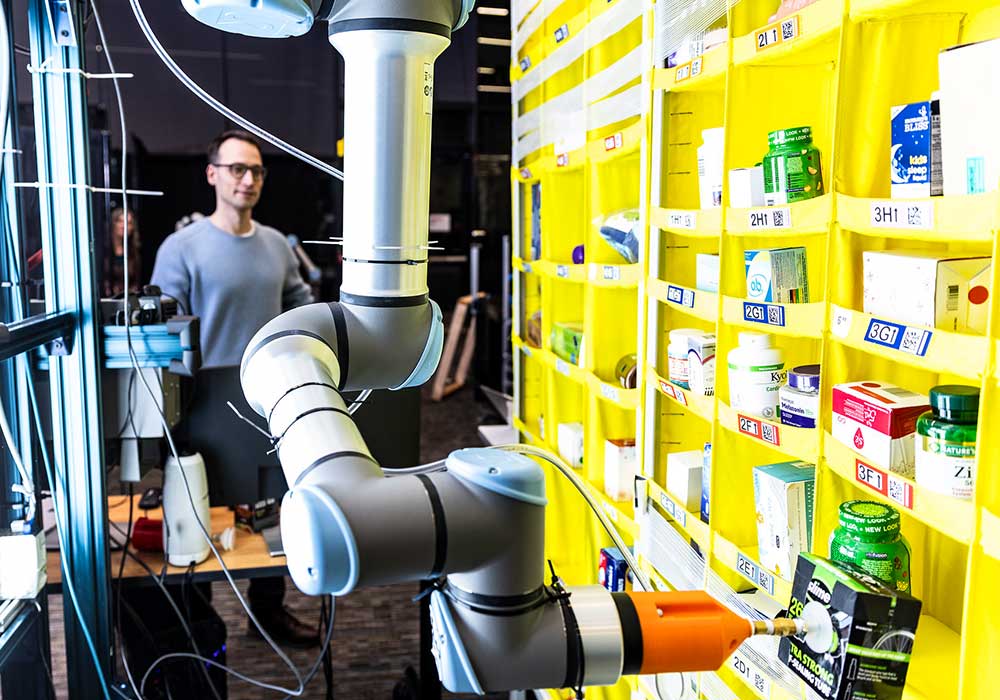
Simulations of an Amazon fulfillment facility in the UW Robotics Lab enable researchers to train autonomous robots to work in complex environments. Dennis Wise / University of Washington
The space where the interests and expertise of these neighbors intersect is the UW + Amazon Science Hub. With emphasis on hub.
“It’s the perfect word to describe this,” says Hub director Karen Leung, an assistant professor of aeronautics and astronautics. “The Hub is meant to be a central place where Amazonians can collaborate with UW researchers on strategic initiatives. It makes starting the conversation really easy.”
The Hub is designed to fund faculty research and student fellowships and to build a community of collaboration through lab tours, symposia, happy hours, recruiting events and lunch-and-learns.
“Scientist-to-scientist connections between Amazon and academia keep all of us focused on the customer problems we most want solved — and the leading research that can help solve those problems,” says Anne Szeto, who heads Amazon Research Initiatives.
Amazon fosters that thinking by funding both exploratory seed projects — small bets to discover what works — and ambitious, multi-year grand challenge programs — big bets to deliver transformative results. “This creates a pipeline from early-stage ideas to real-world impact,” adds Szeto.
Beginning with robotics
Given Amazon’s massive logistical demands, it makes sense that advanced and intelligent robotics was a central focus of the Hub’s foundational activities.
“We in the robotics community used to think we knew how to build robots, the particular architecture and algorithms we could employ,” says Mike Wolf, Amazon’s principal applied scientist in robotics. “AI has upended that. So, interactions with academic researchers — thought leaders who think broadly — help us figure out what the architecture of the future will be. That’s the value of working with a place like the UW.”
Through sponsored and gift-funded projects, UW researchers have developed technologies for robots and robotic systems. For instance, Xu Chen, The Bryan T. McMinn Endowed Professor in mechanical engineering, and Abhishek Gupta, an assistant professor in the Paul G. Allen School of Computer Science & Engineering, are refining learning methods for more dexterous grasping and deft manipulation in crowded, complex environments like fulfillment centers. Natasha Jaques, also an Allen School assistant professor, is combining optimizing and AI learning agents to enable robots to make effective assignments as conditions change. Gonzales, working in Associate Professor Lillian Ratliff’s electrical and computer engineering group, is designing systems to keep autonomous fleets working in sync with their environments — and in harmony with their flesh-and-blood co-workers.

Having the support of Amazon — plus the industry experience and perspective of its scientists — is incredibly helpful in shaping the wild ideas we want to explore into research that has real-world impact.
Karen Leung
Director, UW + Amazon Science Hub
Innovations at industrial scope and scale
Robotic research is only part of the UW + Amazon Science Hub’s portfolio. “As the Hub became more established, different units started reaching out and the connections became a little more organic,” says Leung.
That breadth is reflected in a range of challenges that researchers are tackling. To date, the UW + Amazon Science Hub has funded projects led by more than 50 different faculty members and ten doctoral fellows — representing nine of the ten units in the College of Engineering. Their work spans everything from recyclable packaging to fairer pricing and more reliable pharmacy delivery.
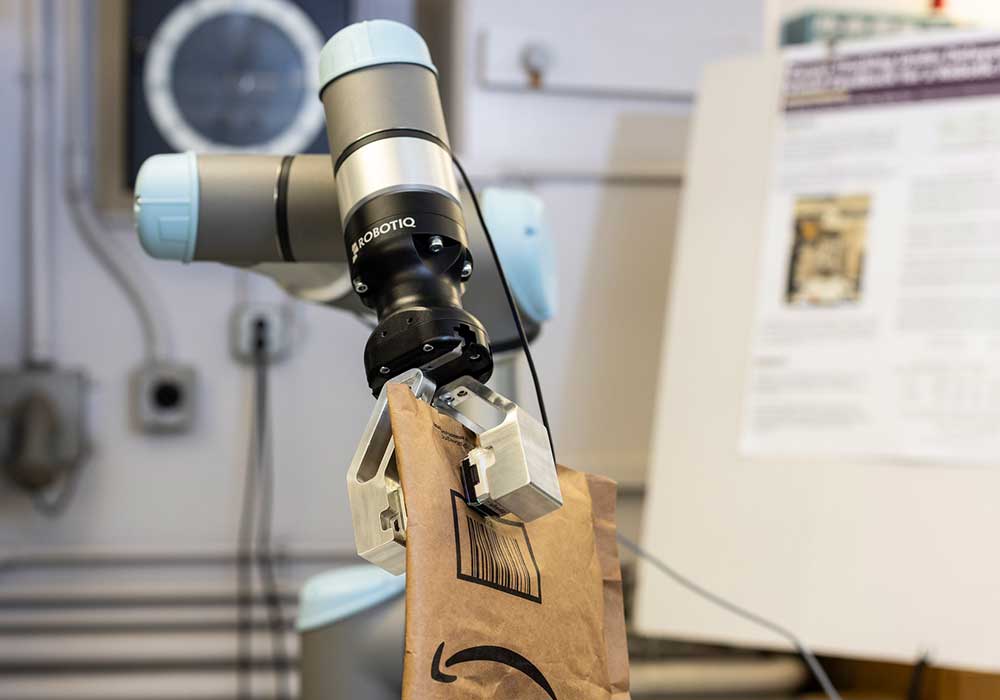
With support from the UW + Amazon Science Hub, Xu Chen’s MACS Lab has developed adaptive robotic grasping using visual and tactile feedback to predict and prevent slippage. Dennis Wise / University of Washington
In materials science and engineering, Associate Professor Eleftheria Roumeli is adding natural polymers to paper packaging to make it stronger, stretchier and easier to recycle. In industrial and systems engineering, Associate Professors Chaoyue Zhao and Shan Liu are addressing two distinct challenges: Zhao has created adaptive computer models to deliver fairer and more effective dynamic pricing, while Liu is modeling Amazon Pharmacy demand to manage inventory and delivery logistics, boost reliability and reduce cost. Julian Marshall, the Boeing International Professor of Civil and Environmental Engineering, is creating a national database of power plant pollution spread to develop and test fast AI assessment tools.
The Hub’s impact extends beyond the research it funds: it also helps make partnership between the UW and Amazon more efficient.
“The Hub made the collaboration much easier to set up and keep running,” says Liu. “Its umbrella research agreement gave us a ready-made framework for data sharing, IP and confidentiality, so we could start the research without negotiating a contract from scratch. The Hub’s administrative support lets our team focus on science.”
The same structure that has enabled collaboration in engineering is now helping the Hub expand into other disciplines at the UW. It recently supported the new Climate Risk Lab at the Foster School of Business, along with projects in the Colleges of the Environment and Arts & Sciences.
For Amazon... for the world
Related story
The research funded through the Hub matches UW’s expertise with Amazon’s operating challenges. It is meant to be applicable — but also accessible. As Gonzales points out, Hub-funded research is open-source and findings are eligible to be published in academic journals.
And, in many cases, the findings offer potential applications beyond Amazon. For instance, autonomous robots designed to interact more safely among humans will be as valuable in a hospital or home as in a fulfillment center.
“The UW + Amazon Science Hub creates an environment where curiosity driven academic research and practical application reinforce each other,” says Amazon’s Szeto. “It is accelerating discovery that neither institution could achieve alone.”
A hub for collaboration and community
Originally published November 16, 2026