
By Ed Kromer
A summer immersion in the epicenter of the modern semiconductor industry — Taiwan — was the experience of a lifetime for UW Engineering students.
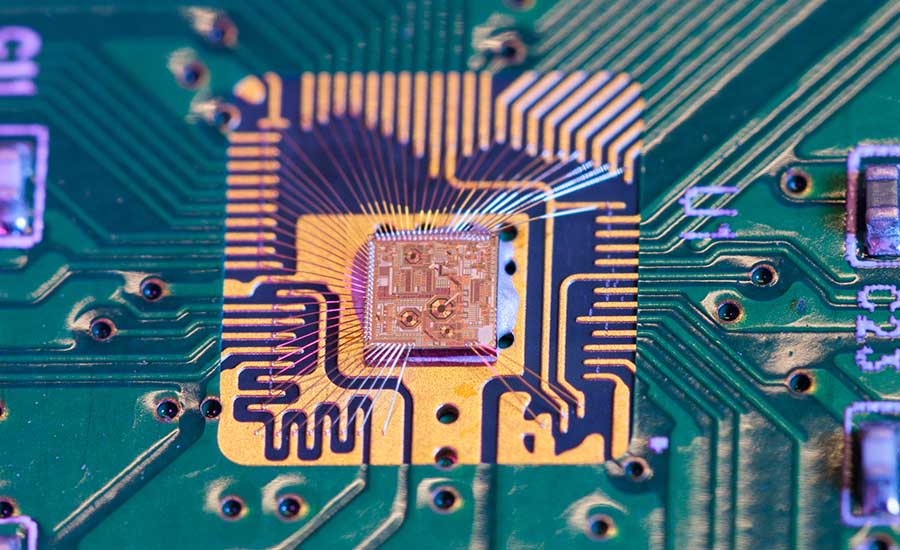
A chip fabricated in Chris Rudell’s lab in the Department of Electrical & Computer Engineering. Photo by Ryan Hoover
In 1976, the Taiwanese government sent a small group of promising young engineers to the United States to learn how to make computer microchips, seeding Taiwan’s rise to global superpower status in the modern semiconductor industry.
In 2026, the University of Washington sent a small group of promising young engineering students to Taiwan to learn how they did it — and continue to do it.
The inaugural Chips2Future summer engineering immersion, piloted and led by UW electrical and computer engineering (ECE) faculty, offered undergraduate students an intensive primer in semiconductor design and production, hands-on practice in world-class facilities and visits to many of the companies that now produce 90 percent of the world’s advanced microchips.
“Chips2Future was much more than just learning theory in a classroom,” says ECE Professor Jenq-Neng Hwang, who developed and directed the program. “It was about opening students’ eyes to see how the Taiwanese semiconductor industry was created and how the infrastructure of its ecosystem works.”
What they did last summer
The students, representing electrical and computer engineering, computer science and engineering, and industrial and systems engineering, were based at Hwang’s alma mater, National Taiwan University (NTU) in Taipei.
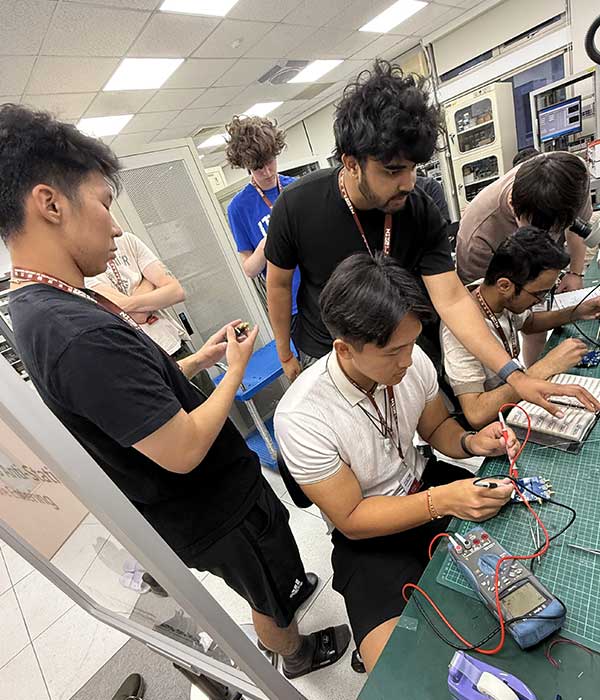
UW Engineering undergraduate students work on circuits at Taiwan Semiconductor Research Institute.
During the first week of the Chips2Future immersion, ECE Professor Anant Anantram provided an intensive introduction to semiconductor devices. Postdoctoral scholar William Livernois, ’22, ’25, delivered the second week’s deep dive into CMOS circuits, the core technology used to construct chips, microprocessors and memory.
In week three, the students tested these advanced semiconductor concepts on real hardware at the state-of-the-art Taiwan Semiconductor Research Institute (TSRI).
The final week featured visits to many of the nation’s leading semiconductor companies and organizations, including MediaTek, Global Unichip, Winbond and Taiwan Semiconductor Manufacturing Company (TSMC). The group also toured the Institute of Pioneer Semiconductor Innovation at National Yang Ming Chiao Tung University and its innovative industry training collaboration.
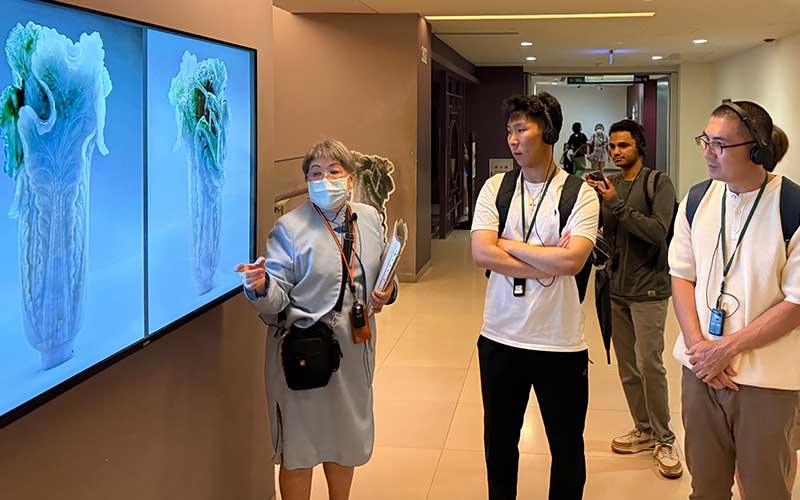
In the margins of Chips2Future, the students visited Taiwan’s cultural sites and museums, traversed its efficient transit system, sampled its culinary mosaic and famed night markets — and beat the summer heat with lots and lots of boba tea (another celebrated Taiwanese export).
Eye-opening experience
Though not a personal fan of boba, ECE senior Akash Savitala found lots to love about the experience. Highlights, for him, were touring the iconic TSMC facility, watching the Wall-E-style robots delivering silicon wafers through the production process at Winbond, visiting museums and temples, and meeting students in the NTU maker space. But the real value was a comprehensive understanding of the semiconductor industry, from concept to manufacture at mass scale.
“That combination,” Savitala says, “helped me connect what I’ve learned in the classroom to the bigger picture of semiconductor development and gave me a much clearer sense of the directions I’d like to explore moving forward.”
In his case, it means shifting from a software path toward the pursuit of quantum computing and the physical concepts behind it.
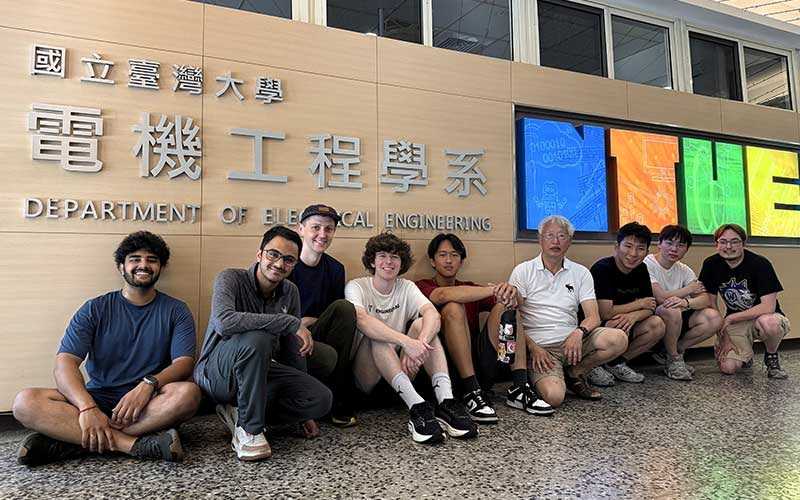
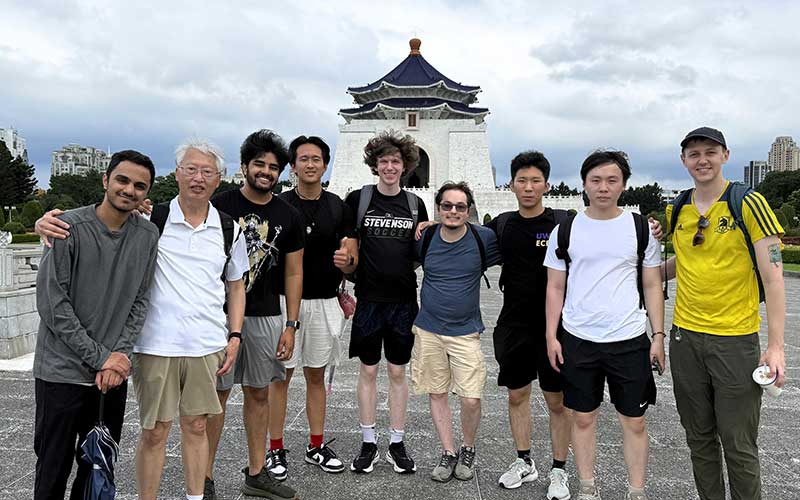
Participants and faculty of the first Chips2Future study abroad immersion visited universities, companies and cultural sites across Taiwan.
Thinking bigger
“Chips2Future is experiential learning at its best,” says Jihui Yang, vice dean of the College of Engineering. “The pilot program demonstrated the power of bringing students, universities and industry together — and laid the groundwork for even stronger partnerships between the UW and Taiwan in the years ahead. I'm grateful to ECE Chair Eric Klavins for supporting the launch of this valuable initiative.”
Chips2Future is experiential learning at its best. The pilot program demonstrated the power of bringing students, universities and industry together — and laid the groundwork for even stronger partnerships between the UW and Taiwan in the years ahead.
Jihui Yang
Vice Dean, College of Engineering
Future iterations could deepen the student experience by drawing on NTU’s academic programs and faculty expertise, creating more opportunities for students from both institutions to work together and, eventually, bringing NTU students to the UW in an education exchange.
For Hwang, who served as a guide throughout the visit to his native Taiwan, the goal of Chips2Future was to provide undergraduates a rare opportunity to experience a critical global industry at its epicenter. Its broader purpose is to build on the academic and industry relationships that have helped Taiwan’s semiconductor sector thrive.
Many of Hwang’s classmates at NTU in the early 1980s went on to graduate studies in the U.S. and then returned to help take Taiwan’s semiconductor industry from promising to preeminent in the ensuing decades. He knows the power of cultural and technological exchange.
“Many of those original engineers who were sent to the U.S. in the 1970s came back and launched companies that built the industry in Taiwan,” Hwang says. “That’s what I’m hoping the students will take away from this experience. In the beginning, they were skeptical about my suggestion. But gradually, it got some of the students thinking bigger — about what they can learn and what their careers could possibly be.”
Read more UW Engineering stories about semiconductors and chips
Originally published September 28, 2026