

Master of Science in Robotics
Lead the future of technology with a program designed to accelerate your robotics expertise with a cross-disciplinary curriculum.
Related information
Also see
Get in touch
Program features
Customize your robotics pathway
Choose from a variety of specializations to tailor the program to your interests and career goals.
Interdisciplinary, emerging areas
Gain a direct pathway to careers in healthcare robotics, autonomous systems, and intelligent manufacturing.
Learn from top robotics experts
Hear directly from top robotics researchers, innovators, and industry leaders.
Foundation meets application
Develop expertise in robotics principles while exploring advancements in AI, machine learning, and human-robot interaction.
Who is this program for?
The M.S. in Robotics is designed for engineering graduates seeking advanced specialization, and traditional full-time students who benefit from a structured, research-informed curriculum. Whether accelerating your career or pivoting into robotics, the program provides training in modern robotics with a direct pathway into emerging sectors such as healthcare robotics, autonomous systems and intelligent manufacturing.
What will you learn?
Students establish a strong foundation in fundamentals of robotics through the core curriculum, and tailor their career objectives and interests with elective courses and capstone components. After the program, students will be able to:
Demonstrate proficiency in robotic system design, modeling, and integration
Apply AI and machine learning techniques to robotic systems
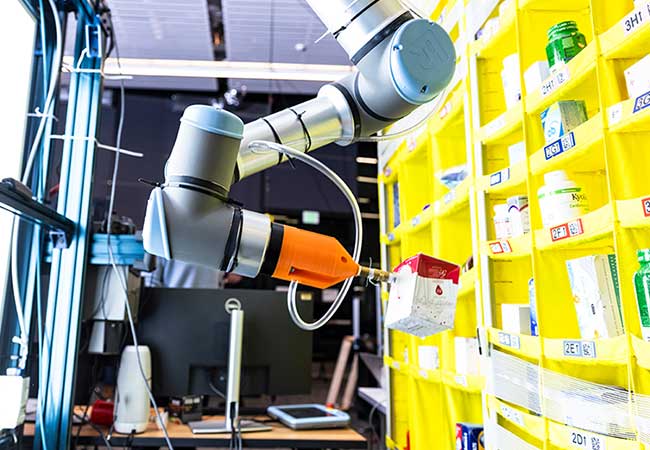
Demonstrate practical experience with state-of-the-art robotics hardware and software platforms
Effectively communicate and collaborate in interdisciplinary and cross-functional teams
Curriculum
The program requires completion of a minimum of 38 credits. This provides students with a comprehensive foundation in robotics balanced with core knowledge, special electives, and hands-on projects designed to provide practical experience in modern robotics and support advanced study.
Modern Robotic Systems I
Introduces the robotics program and core requirements while building a strong foundation in math, modeling and perception. Students learn how robots sense and move, bridging theory with real-world robotic systems and hands-on experiences.
Modern Robotic Systems II
Focuses on how robots think, decide, and act. Covers control systems, motion planning and machine learning, using frameworks like Sense–Plan–Act and end-to-end learning.
Together, Modern Robotic Systems I and II provide students with a holistic understanding of robotics and establishes the foundation for subsequent coursework in specialized concentration areas.
Robotic System Integration and Application
Explores the design and integration of complete robotic systems. Emphasizes real-world implementation, including hardware design, system architecture, and Industry 4.0/5.0 concepts like digital twins and human-robot collaboration.
Together with core courses, students enroll in a weekly seminar course in their second or third quarter that features robotics experts from academia, and industry leaders such as Boeing, NVIDIA, Amazon, Microsoft, Blue Origin and ElectroImpact. Students gain firsthand insight into cutting-edge technologies, real-world applications, and emerging trends shaping the future of robotics.
Students must complete at least 18 elective credits throughout the program. These courses deepen expertise in modern robotics while expanding multidisciplinary knowledge across five key concentration areas aligned with emerging fields.
- Machine Learning and AGI - Focuses on AI and learning algorithms that enable robots to adapt, improve, and operate intelligently in complex environments.
- Perception and Sensing - Explores how robots use sensors (e.g., cameras, LIDAR, IMUs) to understand and interpret the world around them.
- Cognition and Reasoning - Examines how robots make decisions, plan actions, and respond intelligently to dynamic situations.
- Action and Control - Covers robot motion and manipulation, including kinematics, dynamics and actuator control.
- System Integration and Applications - Emphasizes building complete robotic systems by integrating hardware and software with real-world applications across industries such as manufacturing, aerospace, healthcare and autonomous systems.
Students can choose from all elective options to meet the requirements. Program advisers provide students with recommended tracks and sequences following admission in the spring.
The cornerstone of the M.S. in Robotics, the multidisciplinary Robotics Capstone is designed to bridge fundamentals with professional practice, and immerse students in a full lifecycle of complex robotics systems. Students must complete two courses and select from two distinct project pathways:
Pathway 1: The Integrated Challenge
Students operate in a startup-style environment to develop an end-to-end functional robotic system with real-world application, judged by industry advisers.
Pathway 2: Faculty-led specialization tracks (Research pathway)
Students interested in deep technical specialization may apply for specific research tracks led by engineering faculty. The projects focus on advancing state-of-the-art robotics in specific engineering domains, and require rigorous design, validation and theoretical depth.
Note: Pathway 2 requires faculty/program approval.
Admissions and cost
Stay connected with our Robotics programs
Receive admissions updates, information sessions, application deadlines, and other program announcements.
Get program updates