

Graduate Certificate in Applied Robotics
Gain skills in modern robotics with a certificate designed for working professionals, without the need to enroll in a full master’s program.
Related information
Also see
Get in touch
Program features
Flexible programming
Classes are offered primarily in the afternoons and evenings to accommodate working professionals.
Learn high-demand robotics skills
Students gain hands-on experience at the forefront of modern robotics.
Learn from top robotics experts
A weekly seminar features robotics experts from academia and industry leaders.
Work towards a Master's in Robotics
If admitted, students can apply their certificate toward a future master's degree.
Who is this program for?
The Robotics certificate offers a flexible pathway for working professionals and students looking to upskill in high-demand robotics fields. Participants gain essential skills in modern robotics which can be applied to their specific career goals without enrolling in a full master’s program, with the option to apply their certificate toward a future master’s degree. Classes are offered primarily in the afternoons and evenings to accommodate working professionals.
What will you learn?
Students establish a strong foundation in fundamentals of robotics through the core curriculum, and demonstrate their skills through the culminating experience. After completion, students will be able to:
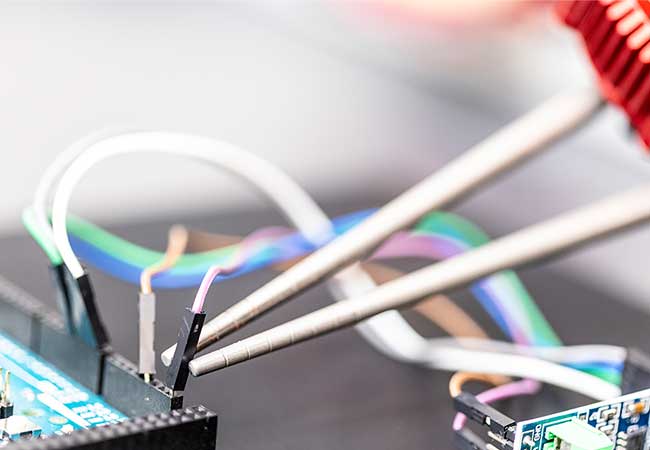
Demonstrate practical experience with state-of-the-art robotics hardware and software
Competently apply artificial intelligence and machine learning techniques to robotic systems
Curriculum
The certificate in robotics requires a minimum of 16 credits that provide a comprehensive foundation in robotics topics, with opportunities for hands-on, practical experience at the cutting-edge of modern robotics.
Modern Robotic Systems I
Introduces the robotics program and core requirements while building a strong foundation in math, modeling, and perception. Students learn how robots sense and move, bridging theory with real-world robotic systems and hands-on experiences.
Modern Robotic Systems II
Focuses on how robots think, decide and act. Covers control systems, motion planning and machine learning, using frameworks like Sense–Plan–Act and end-to-end learning.
Together, Modern Robotic Systems I and II provide students with a holistic understanding of robotics and establishes the foundation for subsequent coursework in specialized concentration areas.
Robotic System Integration and Application
Explores the design and integration of complete robotic systems. Emphasizes real-world implementation, including hardware design, system architecture, and Industry 4.0/5.0 concepts like digital twins and human-robot collaboration.
Together with core courses, students enroll in a weekly seminar course in their second quarter that features robotics experts from academia, and industry leaders such as Boeing, NVIDIA, Amazon, Microsoft, Blue Origin and ElectroImpact. Students gain firsthand insight into cutting-edge technologies, real-world applications, and emerging trends shaping the future of robotics.
The Multidisciplinary Robotics Culminating Experience is designed to bridge fundamental theory with professional practice. After translating high-level problems into engineering requirements, students design a proposal and prototype through a project pathway. Activities include:
- Market analysis
- Fundamental mathematical modeling
- System-level architecture design
- Component selection
- System simulation
- Prototyping
Evaluation is provided by industry partners and prioritizes technical rigor, communication and system performance in a comprehensive final report and a presentation showcase.
Pathway 1: Embedded Project Module
Complete a structured project within a course by defining a robotics problem, building and simulating a solution, and submitting a technical report. Projects are evaluated by the instructor.
Pathway 2: Standalone Applied Project
Work independently or in a small team on a faculty-supervised robotics project. Deliverables include a proposal, simulation/validation, and a final report with a demonstration. Ideal for applying skills to real-world or workplace challenges.
Pathway 3: Early M.S. Capstone Entry
If admitted to the M.S. in Robotics, students can apply their certificate project toward part of the capstone requirement, pending approval. Additional capstone coursework is still required.
Note: Pathways 2 and 3 require faculty/program approval.
Certificate culminating experience vs. M.S. Capstone
The Certificate Culminating Experience differs from the M.S. Capstone in scope, duration and expectations. The certificate culminating experience is a shorter project focused on demonstrating core skills, while the M.S. capstone is a team-based project that covers the full systems engineering lifecycle with formal reviews and a public showcase. The certificate project can serve as an early design step toward the M.S. Capstone and is designed to stack into a future M.S. Robotics degree.
| Feature | Certificate Culminating Experience | M.S. Capstone |
|---|---|---|
| Duration | 1 quarter | 2 quarters |
| Credits | 3 | 7 |
| Team size | Individual or small team | Multidisciplinary team |
| Stackable | Yes | N/A |
Admissions and cost
Stay connected with our Robotics programs
Receive admissions updates, information sessions, application deadlines, and other program announcements.
Get program updates