
« Washington Engineer - August 2006
New center tackles human-to-human and human-to-computer communication
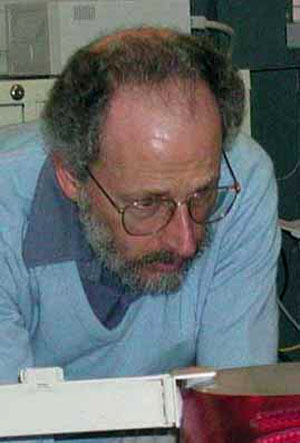
- Jonathan Pool, president of the Utilika Foundation, provided the multi-million dollar gift that launched the Turing Center.
• Go to the Turing Center Web site
• Read about the Utilika Foundation
Anyone who has spent time in a foreign country with a limited grasp of the native tongue can testify to how easily misunderstandings are born and how hard intercultural communication really is.
Toss technology into the picture and you’ve entered the world of Jonathan Pool.
Pool is a former University of Washington political science professor whose foundation recently provided a multimillion-dollar gift to establish the UW’s new Turing Center, a forum dedicated to exploring communication issues from both the human and machine perspective.
“I set up the Utilika Foundation because of my fascination with the communication problem that information technology seems to have bestowed upon the world,” Pool said. “It occurred to me that maybe the language barriers between people and between people and machines weren’t as different as they seemed to be.”
The center, named for Alan Turing, whom many consider the father of computer science, has in one short year launched multiple research projects, seen several papers published, hosted an international array of speakers and sponsors regular lab discussions. Projects include the creation of a semantic Web, or a portion of the World Wide Web that can be easily understood by machines; creating a system to simplify translation of words with ambiguous or multiple meanings; building a “grammar matrix” that encodes grammar rules from many languages so they can be more easily translated from one to another; and facilitating Web search and data mining.
“What we’re trying to accomplish at a very high level is pan-lingual communication and collaboration among human and artificial agents,” said Oren Etzioni, a UW computer science professor and director of the center.
The idea, according to Etzioni, is to be an intellectual crossroads where researchers from multiple disciplines can come together to work on intriguing communication issues with technology overtones.
Those researchers are attempting to answer two fundamental questions:
1. How do people use language?
2. How can a machine understand it?
The questions aren’t as straightforward as they might seem, according to Etzioni.
“Language is an infinite, intricate thing – it is just too complicated,” Etzioni said. “On the other hand, there are also simple parts of language. ‘Where is a Chinese restaurant?’ is very different from a Shakespearean sonnet.”
The idea would be to utilize simpler subsets of language to facilitate communication. The problem is that computers lack the intuitive grasp of the multiple meanings, relationships and context that go into figuring out what a sentence is saying.
Take, for example, the sentence “The pig is in the pen.” Most people would take that to mean a certain type of animal has been corralled in a confined area. But a computer, lacking intuitive language ability, might decide there is a tiny swine inside a writing instrument.
“Computers are very adept at finding ambiguity in things that seem simple,” Etzioni said.
In seeking to address such issues, Pool said he began examining research around the world to decide where Utilika’s assets might best be invested.
“The most enthusiastic, creative and responsive answers came from right here at the UW,” said Pool, who is also based in Seattle. “I decided not to fight it.”
David Notkin, immediate past chair of the UW Department of Computer Science & Engineering and a Turing Center board member, called the center’s work central to integrating technology and society.
“Communication is the core technology for solving any critical problem that the world faces,” Notkin said. “And most of the problems we see are, at the core, communication problems.”
Etzioni admits that the center’s mission is a tall order. But he’s undaunted. He and his colleagues are making inroads and expect to gather momentum as they proceed.
“There are at least 5,000 and as many as 7,000 languages spoken on Earth,” he said. “That’s a lot. But there’s also a Hebrew saying that says even if you cannot complete the task, it is still incumbent on you to engage in it.”