
« Washington Engineer - May 2006
Building dedication makes international headlines
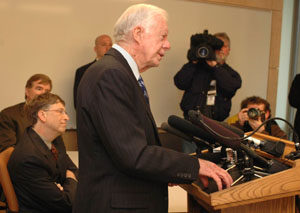
- Former President Jimmy Carter speaks to reporters during a press conference as part of the dedication of the new William H. Foege Building. Carter’s comments put the event on the international news wires.
• Read the Associated Press story
• Read the Seattle Post-Intelligencer story
• Read the Seattle Times story
• Watch a video of the dedication ceremonies
When former President and Nobel Peace Prize laureate Jimmy Carter agreed to a brief news conference as part of his appearance as keynote speaker to dedicate the University of Washington's new William H. Foege Building, event organizers had no idea that the arrangement would guarantee coverage of the festivities around the world.
During the 10-minute meeting with the press, one reporter asked Carter to give his viewpoint on the war in Iraq. Carter pounced on the opportunity to voice his displeasure.
“It was a completely unnecessary war. It was a completely unjust war. It was initiated on the basis of false pretenses,” he said. “All of that is true, but we are already there. We can't preemptively withdraw. It would cause a civil war. We are on the verge of a civil war.”
The violence in Iraq is escalating every month, Carter continued. “My prayer is that we will see some kind of stable democratic government evolve.”
If that can be accomplished, he added, he would like to see U.S. troops coming home as soon as possible.
“Other than that,” he joked. “I think things have gone well.”
An Associate Press reporter at the conference led his report with Carter’s sharp criticism of the war, then included details about the event that followed. The story went out on the AP wire and appeared in publications around the country, including the New York Times and the Washington Post, as well as outlets overseas.
UW ‘Master of Disaster” featured in magazine story
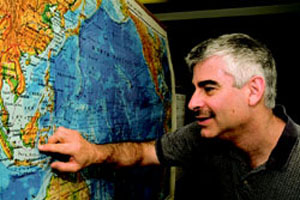
- Mark Haselkorn, professor in the UW Department of Technical Communication, is leading a project that examines the logistical side of disaster, with the aim of getting supplies and support to people in need more quickly and efficiently.
• Read the Columns story
• Read a UW news release on Haselkorn's work
In the wake of Hurricane Katrina, the destruction it wrought along the Gulf Coast and the government’s widely criticized response, Columns magazine ran a lengthy feature on the UW’s new Interdisciplinary Program in Humanitarian Relief.
In the article, Technical Communication’s Mark Haselkorn, founding director of the program, and his colleagues discuss issues in disaster response that are often lost in the emotional outpouring that follows such calamities. The group’s work in figuring out how communication and logistics can be more efficiently handled to make response fast and effective is helping to rewrite how disasters should be managed.
VR guru Hunter Hoffman makes Fast 50, Today Show
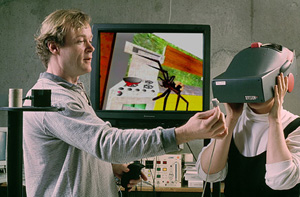
- UW Research Scientist Hunter Hoffman takes a patient through Spiderworld, a virtual reality program that helps people overcome spider phobia.
• Read the Fast 50 list
• View a UW news release on Hoffman's work
Hunter Hoffman, an expert in virtual reality who studies how VR can be used to manage pain and treat phobias, has been named to edgy business magazine Fast Company’s 2006 Fast 50 list of people “who are writing the history of the next 10 years.” Included with Hoffman are the likes of former President Bill Clinton and Microsoft Chairman Bill Gates.
Hoffman had an opportunity to demonstrate his craft to millions of viewers recently when he appeared on the Today Show with Katie Couric. With Hoffman’s guidance, Couric donned a VR helmet and experienced “Spiderworld,” an immersive program that Hoffman uses to treat people suffering from spider phobia. One of Hoffman’s subjects then demonstrated how effective the treatment had been for him by allowing a tarantula to crawl on his hand.
ME’s Joyce Cooper and students featured in Seattle TV special
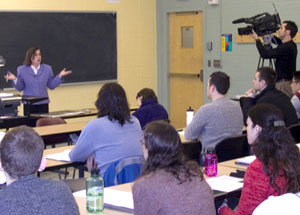
- A Seattle TV cameraman films Professor Joyce Cooper as she teaches her Design for the Environment class.
• Watch the video
• Go to the Design for Environment Lab
Mechanical Engineering Professor Joyce Cooper, whose research focuses on fuel cells and environmentally friendly life cycle management of products, caught the interest of the Seattle Channel early this year. The channel sent a film crew to her Sustainability and Design for Environment Class to get video of Cooper teaching engineering students about the issues involved in designing technologies that meet people's needs but also sustain the environment for future generations.
The video segment, titled “New School Engineering,” also features shots in Cooper’s Design for Environment Lab of students disassembling computers and evaluating the components for recyclability. The video also shows several student presentations and includes interviews with ME students Dustin Miller and Brandon Arteaga. Cooper said the intent of the course, which draws students from a variety of disciplines, is to get class members to consider how the products we create impact the environment by getting them to look more broadly at the life cycle of those products – how they are used and how they are thrown away.
Computer scientists prompt international chatter with spyware study
• Read the study
• Read the UW news release
Hank Levy and Steve Gribble in the Department of Computer Science & Engineering have prompted a good deal of international discussion, both in the mainstream media and the tech community, with a study that evaluates the threat spyware poses on the Internet.
The study found that, although the saturation of some types of spyware had decreased, overall the threat remained extensive and pervasive. The study examined popular categories of Web sites, and found the greatest risk of “piggyback” attacks at game and celebrity sites, while sites that offer pirated software posed the greatest risk for “drive-by” attacks.
The story was picked up United Press International and appeared in media outlets around the world.