
« Washington Engineer - October 2005
Teamwork spawns ‘smart windows’ for new jet airliners
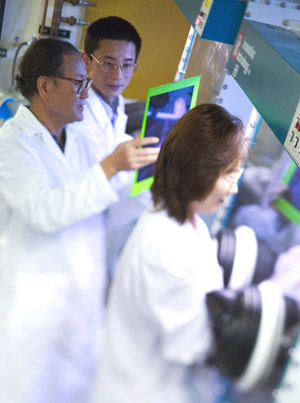
- Minoru Taya, left, and his research team have developed smart windows that transition from clear to opaque at the flip of a switch.
When new jet airliners roll off the Boeing factory floor in the near future, chances are good the huge craft will boast dimmable windows. UW engineers are developing a type of dimmable window that uses a chemical reaction to go from clear to shaded with the flip of a switch instead of the pull of a shade.
The innovation, which could make the aircraft more convenient for flight crews as well as passengers, is the result of a fortunate research accident and the teamwork that followed, according to a group of engineers in the UW Department of Mechanical Engineering.
“Initially, we were working on an antenna application for Boeing Phantom Works where switching of electromagnetic properties is important,” said Minoru Taya, professor of mechanical engineering and director of the Center for Intelligent Materials and Systems. “We were asked to produce a material that changes its conductivity radically, from a semi-conductor to a conductor state. As an accompaniment to that, we also discovered this change from a transparent to a color state.”
The process that makes the windows work is called redox switching, short for reduction and oxidation. Layered between a smart window’s glass panes is an electrochromatic polymer – a compound composed of long chains of molecules that undergo a chemical reaction when electrical current is applied.
Generally, when the current is increased the chemical reaction causes the windows to become progressively more opaque. When current is decreased, they become more transparent.
The windows would make a good fit for jetliners, Taya said. When flight crews have to darken the interior of the aircraft – for an inflight movie, for example – they will no longer have to ask passengers to pull the shades or awaken those sitting by windows who have fallen asleep.
“They can just flip a switch,” Taya said.
But, he added, there’s also a big potential market for the technology in offices, homes and cars.
“One of the advantages to this is that is much more scalable to a large size than other alternatives, like LCD,” he said. “And it can be done at a much lower cost.”
Taya credits a strong partnership with Boeing and a goals-oriented research team for the rapid pace at which the technology has been developed. The initial discovery occurred less than five years ago, and it’s likely commercialization will begin in the next few months.
“That process usually takes at least 10 years,” Taya said. “Typically, university professors in this area are very science-oriented and like to publish a lot of papers, give presentations. But we are also a mission-oriented team.”