
« Washington Engineer - October 2005
Engineering creates endowed deanship with $4 million gift
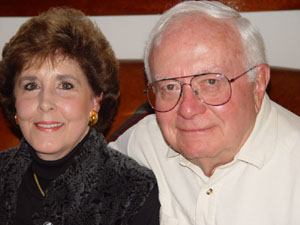
- Frank and Julie Jungers have added clout to the search for a new engineering dean with a $4 million gift to create a deanship.
A $4 million donation from Frank and Julie Jungers will create an endowed deanship in the University of Washington’s College of Engineering.
“This wonderful gift comes at a propitious moment, as we search for the college's next dean,” said UW President Mark A. Emmert. “This endowment will enable us to offer a more competitive salary and also provide the new dean additional funds for innovation in education and research. Most private funding is designated for specific purposes. This gift will give us another tool in attracting the very best individual for this key position. We'd like to thank Frank and Julie Jungers for their generosity.”
Frank Jungers graduated from the UW in 1947 with a degree in mechanical engineering. He spent most of his career in Saudi Arabia, ultimately serving as chairman and CEO of Aramco, the Arabian American Oil Company, one of the largest oil corporations in the world.
“It's my hope that this gift will ensure that the College of Engineering is able to obtain the very best leadership available,” Jungers said.
For many years, Jungers has been a generous donor to – and an active volunteer for – the UW, particularly the College of Engineering. In 1987, he established the Frank Jungers Endowed Professorship in the college. Through additional gifts, he increased that professorship to a chair.
Jungers and his wife divide their time between Portland and Bend, Ore. They have also been generous donors to Oregon Health Sciences University in support of multiple sclerosis research.
Bioengineering prof gets $15 million from Gates Foundation group for pocket-size diagnostic device
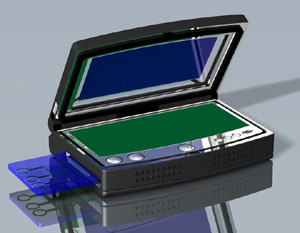
- The “Diagnostic Box” promises to bring high-tech lab testing to remote regions of the world. UW bioengineer Paul Yager has received $15 million to develop the concept.
Read the release from the Bill & Melinda Gates Foundation
The University of Washington has been awarded a $15.4 million grant as lead partner of a regional consortium to develop a portable device that promises to bring the technological power of a modern medical diagnostics center to the remote regions of the world.
The award was announced this week as one of 43 groundbreaking research projects to improve health in developing countries, supported by $436 million from the Grand Challenges in Global Health initiative.
The consortium is a collaboration of academic, industry and non-profit partners. In addition to the UW, it includes PATH, Micronics Inc. and Nanogen Inc., all of which have facilities in Washington state.
“This is a formidable group,” said Paul Yager, professor and vice chair of the UW Department of Bioengineering and lead investigator on the project. “Each partner brings vital skills and experience to the mix. I believe this combination is what led to our being selected from such a wide range of applicants and it’s what will make our efforts successful.”
The project is aimed at developing and testing prototypes of a device about the size of a handheld computer that healthcare workers could pack into remote regions to quickly and easily make life-saving diagnoses.
Developing countries have limited resources to accurately and easily test patients for preventable life-threatening diseases, such as malaria and typhoid fever. The consortium’s efforts will concentrate on filling the need for an affordable, portable device to do on-the-spot tests and provide results in a matter of minutes.
The Grand Challenges in Global Health initiative is a major international effort to achieve scientific breakthroughs against diseases that kill millions of people each year in the world’s poorest countries. It is funded with a $450 million commitment from the Bill & Melinda Gates Foundation, $27 million from the Wellcome Trust, and $4.5 million from the Canadian Institutes of Health Research. The Gates Foundation funding includes a $200 million commitment managed by the Foundation for the National Institutes of Health.
Weyerhaeuser bolsters support for minorities in engineering
Minority groups have an easier path to engineering and the sciences at the University of Washington, thanks to a recent gift from the Weyerhaeuser Company Foundation.
The $250,000 gift will work within the Mathematics, Engineering, Science Achievement, or MESA, program to target talented students from groups that are underrepresented in engineering and science, such as African Americans, Native Americans, Hispanics and women.
MESA seeks to pique the scientific interest of middle and high school students from those groups by involving them in hands-on projects that give the taste of what science and engineering are all about. The program encourages students to continue their academic pursuits by attending college and pursing careers in the field.
The new endowment will offer university scholarships to outstanding MESA participants.
Campaign begins to complete funding for Guggenheim renovation
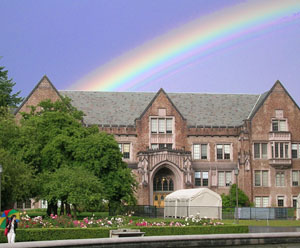
- Historic Guggenheim Hall is, indeed, at the end of the rainbow, as evidenced by this recent photo. Now officials are looking for a pot of gold to complete funding to renovate the aging structure. (Photo by Professor Buddy Ratner)
Guggenheim Hall, one of the oldest buildings on the UW campus and among the university’s most stately structures, needs help to modernize.
Home to the College of Engineering's Department of Aeronautics & Astronautics – one of the top air and space programs in the country – Guggenheim is in need of updated labs and classrooms so the department can maintain its cutting-edge status in education and research. The aging structure also needs to be reinforced to meet current earthquake standards.
Renovation starts in October 2006 and will cost $32.8 million. The state has provided $27.8 million, leaving $5 million that must be raised as private gifts.
“This is an opportunity for our friends to be involved in part of the history of the campus and the college,” said Mani Soma, acting dean of engineering. “We're looking forward to working together to modernize Guggenheim, while retaining its old charm.”
For more information about helping in the effort, contact Paul Julin at (206) 685-1927 or julin@engr.washington.edu.